


Google AI Overviews are AI-generated summaries, built on Google's Gemini models, that appear at the top of some search results and link to the pages they draw from. At Google I/O 2026, Sundar Pichai said AI Overviews now have over 2.5 billion monthly active users. Ahrefs' December 2025 data shows the top-ranking page's average click-through rate is 58% lower when an AI Overview appears. To be cited, a page must be indexed and eligible to show with a snippet. After that, it has to answer the question more clearly than every other candidate.
You've probably read the two usual takes on this: SEO is dead, or you need a new acronym. Neither helps. The pages that get cited answer fast, name their author and source every number, which was good SEO before Gemini arrived and still is.
Key Takeaways on Google AI Overviews
Google AI Overviews summarize answers at the top of search results, reduce clicks to the pages below them, and cite pages that are indexed, clear and trustworthy.
The five points worth keeping from this guide are:
- AI Overviews show up mostly on informational, question-style searches and far less on transactional ones.
- Clicks and organic traffic drop when an AIO appears, though recent data shows a partial recovery.
- There's no special file or markup to add. Eligibility starts with normal indexing.
- Answer-first sections, named authors and cited sources give Google clean passages to quote.
- Citations move around, so track the trend in Search Console instead of trusting one screenshot.
What Are Google AI Overviews?
Google AI Overviews are AI-generated summaries shown at the top of some Google results, with links to the sources used to write them.
Google treats them as permanent. Its help center calls AI Overviews "a core Google Search feature, like knowledge panels". That's a polite way of saying they aren't going anywhere.
The Gemini Models Behind AI Overviews
AI Overviews run on Gemini, Google's family of AI models, tuned specifically for search. At launch in May 2024, they used a new Gemini model customized for Google Search, with multi-step reasoning.
In December 2024, Google said it was bringing Gemini 2.0's reasoning to AI Overviews for complex questions, including math, multimodal queries and coding. Each upgrade widened the kind of question an AIO will attempt. Fewer queries are safe from them than you'd hope.
How Far AI Overviews Have Spread
AI Overviews went from a U.S.-only launch in May 2024 to more than 200 countries and territories within about a year. Google began rolling them out across the U.S. at I/O 2024 and predicted they'd reach over a billion people by the end of that year.
That forecast landed early. By October 2024, AI Overviews were reaching more than 1 billion users every month in over 100 countries and territories. By May 2025, they covered more than 200 countries and 40-plus languages.
If your customers use Google, they see these. That settles whether to plan for them. The next question is how they differ from the SERP features you already know.
How AI Overviews Differ From Featured Snippets and AI Mode
AI Overviews combine information from several sources into one generated answer, while featured snippets quote a single page and AI Mode is a separate conversational search mode.
A featured snippet lifts one passage from one page. You won the box or you didn't. An AI Overview writes its own answer and cites several pages, so you're one voice in a group summary.
To build that answer, Google may use "query fan-out," running several related searches and combining what it finds. AI Mode goes further. It's a separate space for exploratory, back-and-forth questions.
One trap when reading Google's announcements: AI Overviews and AI Mode audiences overlap, so don't add their user counts together.
For planning, write for fan-out. Cover the obvious follow-up questions on the same page, because each one is another search Google might run. That matters more once you see what happens to clicks.
AI Overviews Cut Clicks, but the Numbers Keep Moving
AI Overviews reduce organic click-through rate on the queries where they appear, according to independent studies from Pew Research Center, Ahrefs and Seer Interactive.
What the Click Studies Found
Pew Research Center tracked 900 U.S. adults in March 2025, and 58% ran at least one search with an AI summary. This is a mainstream experience, not a niche one.
When a summary appeared, users clicked a traditional result on 8% of visits versus 15% without one. Close to half the clicks, gone.
And being cited doesn't make up the gap. Users clicked a link inside the AI summary on just 1% of visits. A citation is good for your brand. It's a weak source of visits.
Ahrefs puts the damage at the top of the page. Its December 2025 data shows the number-one result's average CTR is 58% lower when an AI Overview is present. Ranking first still matters. It just pays less.
Why the Traffic Story Is Messier Than the Headlines
Organic CTR on AI Overview queries started recovering in early 2026 after a long decline. Seer Interactive found that CTR on those queries rebounded 85% in two months, following 18 months of decline.
Check the base before celebrating. Search Engine Land's report on Seer's data shows CTR rose from 1.3% to 2.4% between December 2025 and February 2026, across 53 brands and 5.47M queries. Very low to still low.
Google sounds calmer. Head of Search Liz Reid said in August 2025 that total organic click volume was "relatively stable year-over-year". Total volume across the web can hold steady while your organic traffic falls.
All of these CTR studies are correlational, and results vary by dataset and method. Treat them as ranges, then check your own Search Console numbers. Which queries you target decides how much any of this touches you.
Which Queries Trigger AI Overviews?
AI Overviews appear mostly on informational queries, such as long-tail questions and how-to searches, and much less on transactional or navigational searches.
Intent Decides Whether an AIO Shows Up
Ahrefs found that 99.2% of keywords triggering AI Overviews had informational intent in March 2025. If your blog is full of "what is" and "how to" posts, you're in the blast zone. Your pricing page mostly isn't.
Frequency still swings. Semrush's study of 10M+ keywords found AI Overviews on 6.49% of queries in January 2025, peaking at 24.61% in July before settling near 16% by November. A keyword with no AIO today can have one next month.
The mix is creeping toward buying research. Between November 2025 and April 2026, AI Overviews on commercial-intent results grew 71% on average, while transactional results fell 5%. B2B and SaaS teams should watch their comparison and "best X for Y" pages closely.
Use People Also Ask to Map the Questions
People Also Ask boxes show the follow-up questions searchers type, which makes them a free map of what an AI Overview needs to cover.
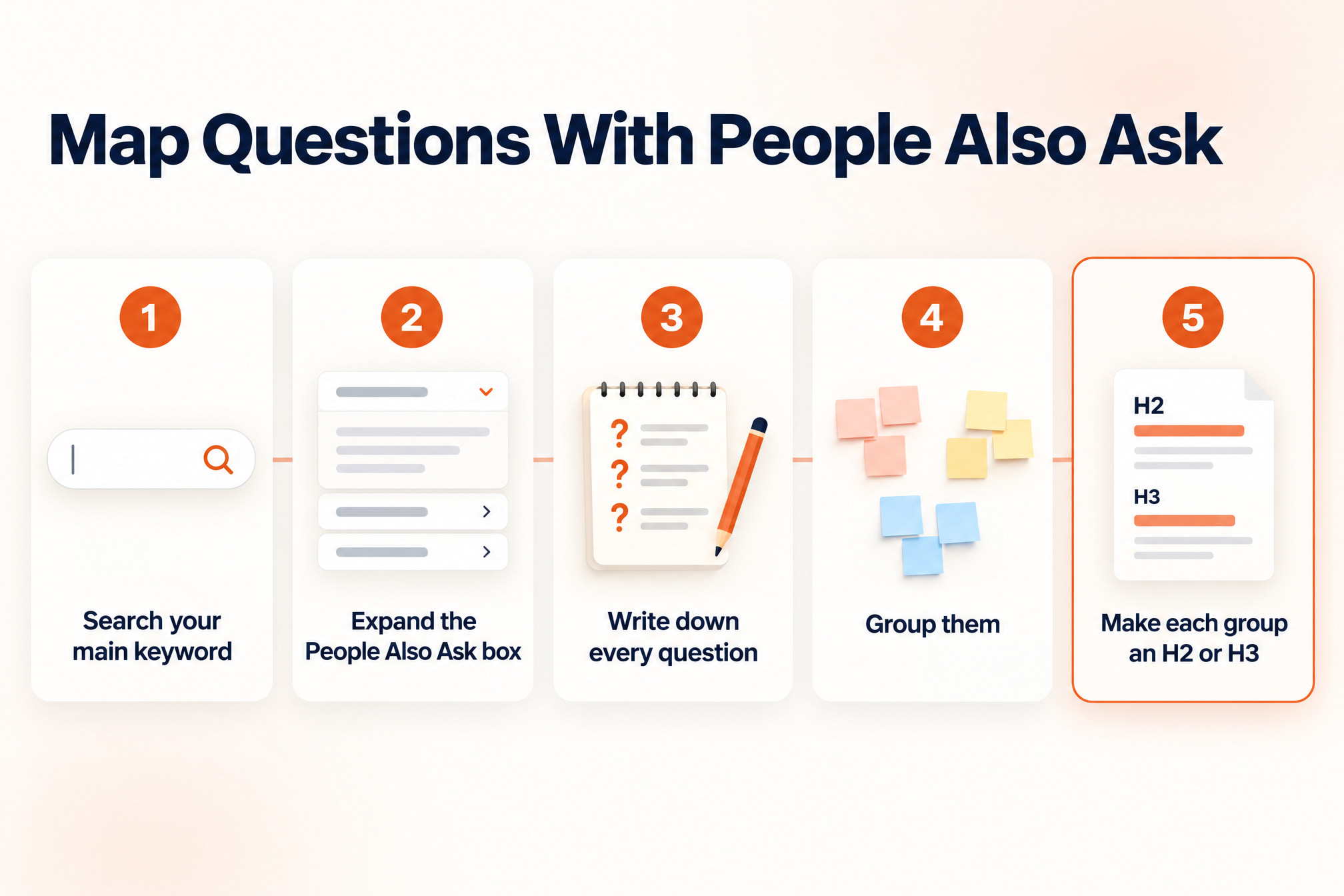
Search your main keyword, expand the People Also Ask box, and write down every question. Group them. Each group becomes an H2 or H3, answered in its first two sentences.
This lines up with query fan-out. A page that already answers the related questions gives Google fewer reasons to look elsewhere. Serpjoy reads People Also Ask and the live AI Overview before writing any post for the same reason.
How Google Chooses Which Pages to Cite
Google cites pages in AI Overviews only if they are indexed and eligible to appear in Search with a snippet, and Google says there are no additional technical requirements.
That's the entry ticket. No llms.txt file, no special AI markup. Google says you don't need either.
One newer condition matters. Google's July 2026 AI optimization guide says a site must be included in generative AI features in Search Console. Check that setting before you touch any content.
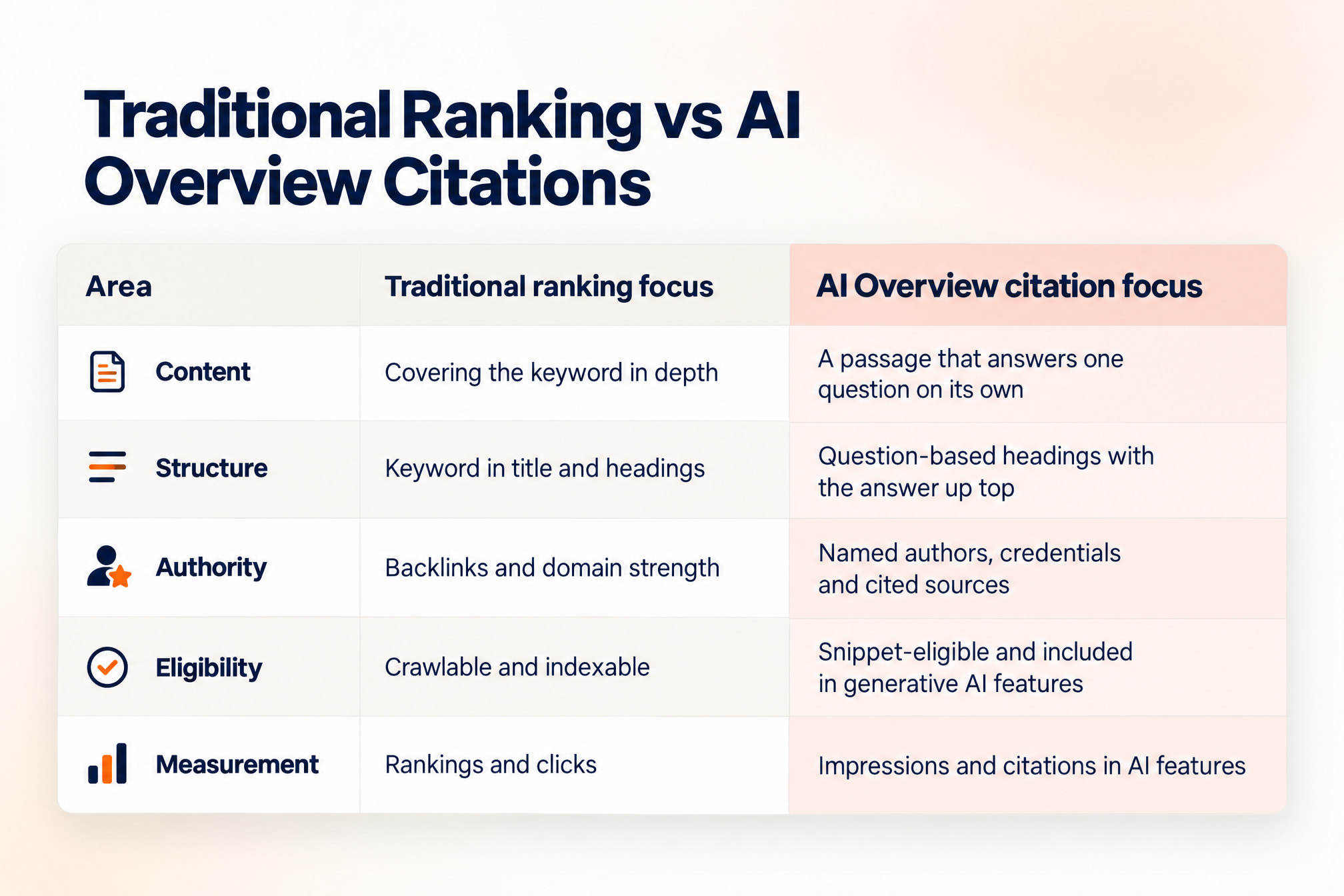
A first-page ranking puts you in the candidate pool. It doesn't get you picked. The emphasis shifts from classic ranking signals to what makes a passage easy to quote, as this comparison shows:
| Area | Traditional ranking focus | AI Overview citation focus |
|---|---|---|
| Content | Covering the keyword in depth | A passage that answers one question on its own |
| Structure | Keyword in title and headings | Question-based headings with the answer up top |
| Authority | Backlinks and domain strength | Named authors, credentials and cited sources |
| Eligibility | Crawlable and indexable | Snippet-eligible and included in generative AI features |
| Measurement | Rankings and clicks | Impressions and citations in AI features |
You'll hear this called Answer Engine Optimization (AEO) or Generative Engine Optimization (GEO). They're labels for one idea: write so a machine can lift a correct answer from your page. The same work carries over to ChatGPT, Perplexity and Copilot, which also build answers from web sources.
How to Rank in Google AI Overviews: 9 Steps
Getting cited in Google AI Overviews comes down to eligibility, answer-first structure, visible E-E-A-T, clean technical SEO and regular measurement.

Work through these nine steps in order:
- Confirm you're eligible. Check the page is indexed and not held back by
noindex,nosnippetormax-snippet. Then confirm the Search Console setting for generative AI features. - Answer in the first two or three sentences. Open each section with a 40-70 word answer capsule that makes sense alone. No warm-up.
- Use question-based headings. Write H2s and H3s the way people search. Google lifts passages, so each section has to stand on its own.
- Make E-E-A-T visible. Add an author bio with real credentials, describe first-hand experience where you have it, and link every statistic to its original source.
- Add schema markup that clarifies who and what. Google says no special markup is needed, so structured data won't win citations by itself. Use Article, Organization and Person schema markup to tie pages to a real author, plus FAQ schema (FAQPage) or HowTo where the format fits. Validate it in the Rich Results Test.
- Build topical authority. Cover a subject with a pillar page and cluster posts, linked internally. One post rarely convinces Google you know a topic.
- Keep technical SEO clean. Pass Core Web Vitals, work well on mobile and stay crawlable. Check robots.txt isn't blocking Googlebot, and follow Google's image and video SEO guidance.
- Refresh on a fixed schedule. Update statistics, show a visible "last updated" date and cut claims that aged badly. An old stat tells readers the page is stale.
- Measure in Search Console. Google's Search Generative AI performance reports show impressions in AI Overviews, AI Mode and Discover. As of August 31, 2026, every site worldwide has access.
Expect citations to wobble. A page can drop out of an AIO with nothing changed on your end, so the trend beats any single check.
This is the checklist Serpjoy writes to. Every stat is paired with its source, authors get asked two or three questions where their experience matters, and every post ships with schema.
Common AI Overview Mistakes That Cost Citations
The most common AI Overview mistakes are burying the answer, publishing unsourced statistics, building files Google doesn't use and opting out without data.
The mistakes worth fixing this week:
- Warm-up intros. If your answer sits in paragraph four, a competitor's first sentence gets quoted instead.
- Stats with no source. A number without a link is a number Google has to take on faith.
- Building llms.txt for Google. Google says special files and new markup aren't needed for AI Overviews.
- Opting out on instinct. Google's June 2026 toggle lets sites opt out of generative AI features, and Google says it isn't a ranking signal elsewhere. It also removes you from the citations, so decide with your own numbers.
Quick Answers About Google AI Overviews
Google AI Overviews appear automatically on some searches, can't be switched off in settings, and link to their sources so you can check the answer.
How Do You Get an AI Overview?
You get an AI Overview by searching a question or informational query, since Google shows them automatically on some searches. For site owners, being cited starts with an indexed, snippet-eligible page.
Why Do I Keep Getting AI Overviews?
You keep getting AI Overviews because Google treats them as a permanent Search feature, and they show up most on informational questions.
How Can I Turn Off AI Overviews?
You can't turn off AI Overviews in Google's settings, but choosing the "Web" filter shows only text links. Site owners can use the Search Console opt-out instead.
Should I Trust Google AI Overviews?
Google AI Overviews are a starting point, so click the cited sources before acting on anything important. A short summary can't carry every caveat.
What to Do About AI Overviews This Week
AI Overviews are a permanent part of Google Search, so the practical response is to make your page the clearest, best-sourced answer on the results page.
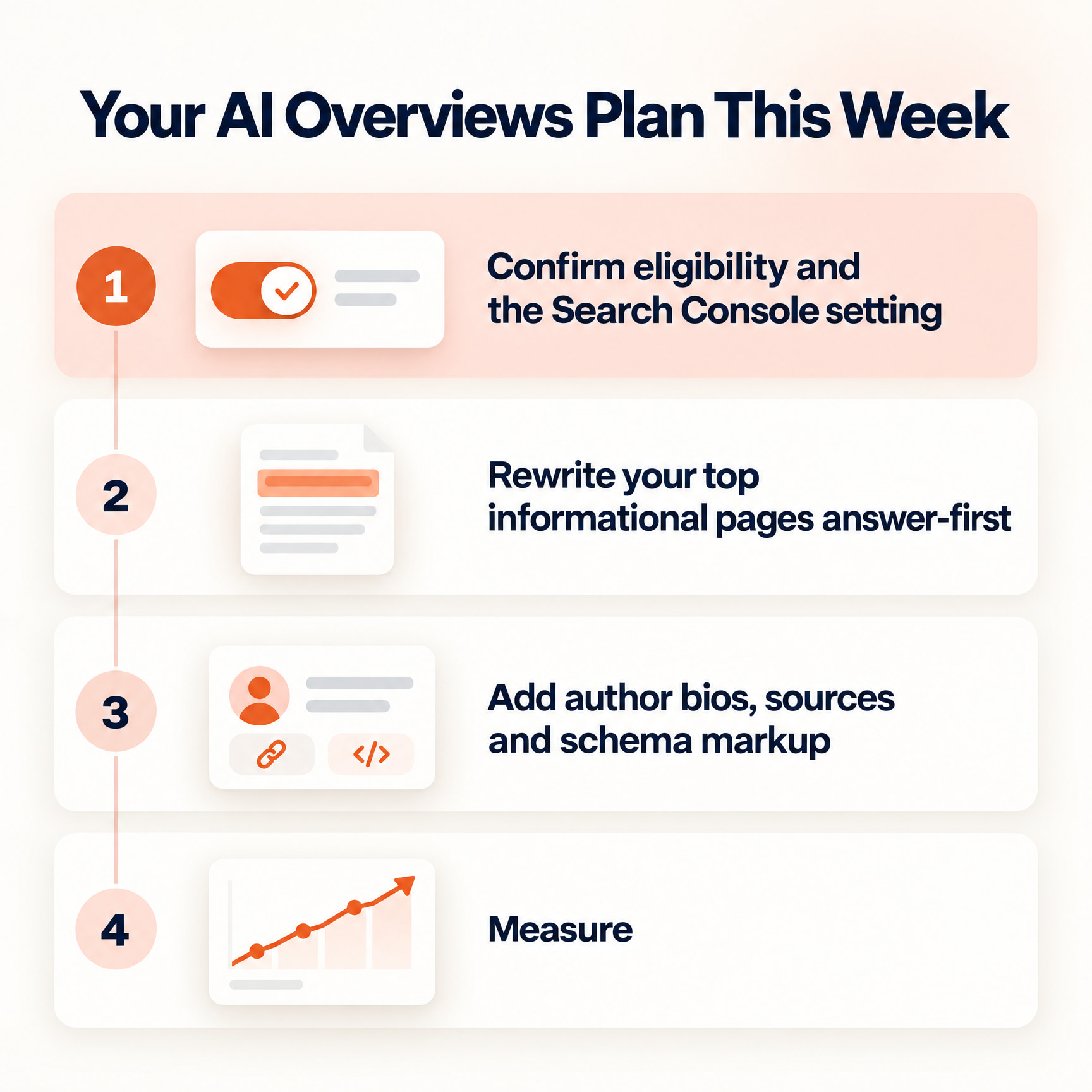
Do it in this order. Confirm eligibility and the Search Console setting. Rewrite your top informational pages answer-first. Then add author bios, sources and schema markup, and measure.
Your first step today: open Search Console, find the Generative AI performance report and list the pages already earning AI Overview impressions. Those are your proof of concept.
Within seven days, aim to have your five strongest informational pages rewritten with answer-first openers and every stat linked. That's a realistic week, and it moves the needle more than any new acronym.
If you'd rather not do it by hand, Serpjoy researches, cites and writes in your voice. Consult Now's active users rose 498% after it started publishing Serpjoy posts in late July 2026, and your first post costs $1.
Answer the question in sentence one. The rest is supporting detail.