
A content distribution strategy is a written plan for where, when and in what format you publish, share and promote each piece of content, so it reaches people instead of sitting on your blog. The short method is to pick the two or three channels your audience already uses and cut every piece into formats for those channels. Then put it on a calendar and measure each channel on its own terms.
The reason to write it down is search. Pew Research tracked the browsing of 900 U.S. adults in March 2025. Pew found Google users clicked a traditional result in 8% of visits when an AI summary appeared, against 15% when none did. Hoping Google sends readers is no longer a plan. It's a wish with a publish button.
A Content Distribution Strategy Plans Three Jobs Before You Write
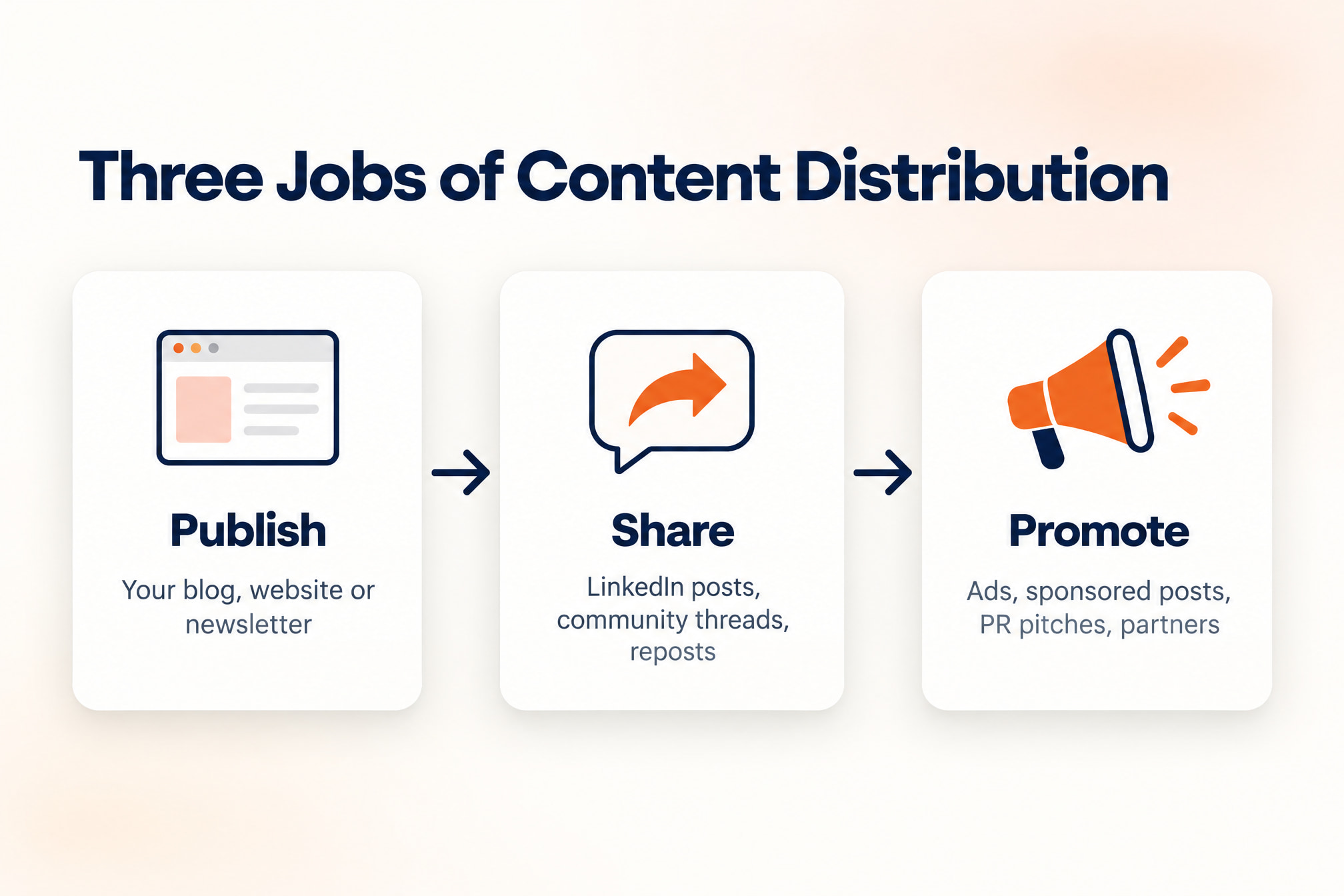
Most teams plan only one of the three jobs in content distribution. Publishing puts the piece on channels you run, like your blog, website or newsletter. Sharing puts it in front of audiences on other platforms, through a LinkedIn post, a community thread or a colleague's repost. Promoting pushes it further with money or relationships, through ads, sponsored posts, PR pitches and partners.
A strategy decides all three before the first draft exists. The order matters because the destination changes the writing. A post that will become a short video needs a moment worth filming. A post headed for a newsletter needs a section that stands alone. Work out distribution after publishing and you end up forcing a long article into a LinkedIn post it was never shaped for.
Content strategy and distribution strategy are related but different. Content strategy decides what to make and why. Distribution strategy decides how each piece gets seen, by whom and how often. Small teams usually have the first and skip the second.
Publishing and Waiting for Google Stopped Working
Search clicks are shrinking, social feeds are packed with paid posts and the buyers worth reaching now read in many places besides Google. Each of those makes an unpromoted post less likely to be seen. Publishing alone seldom brings enough traffic.
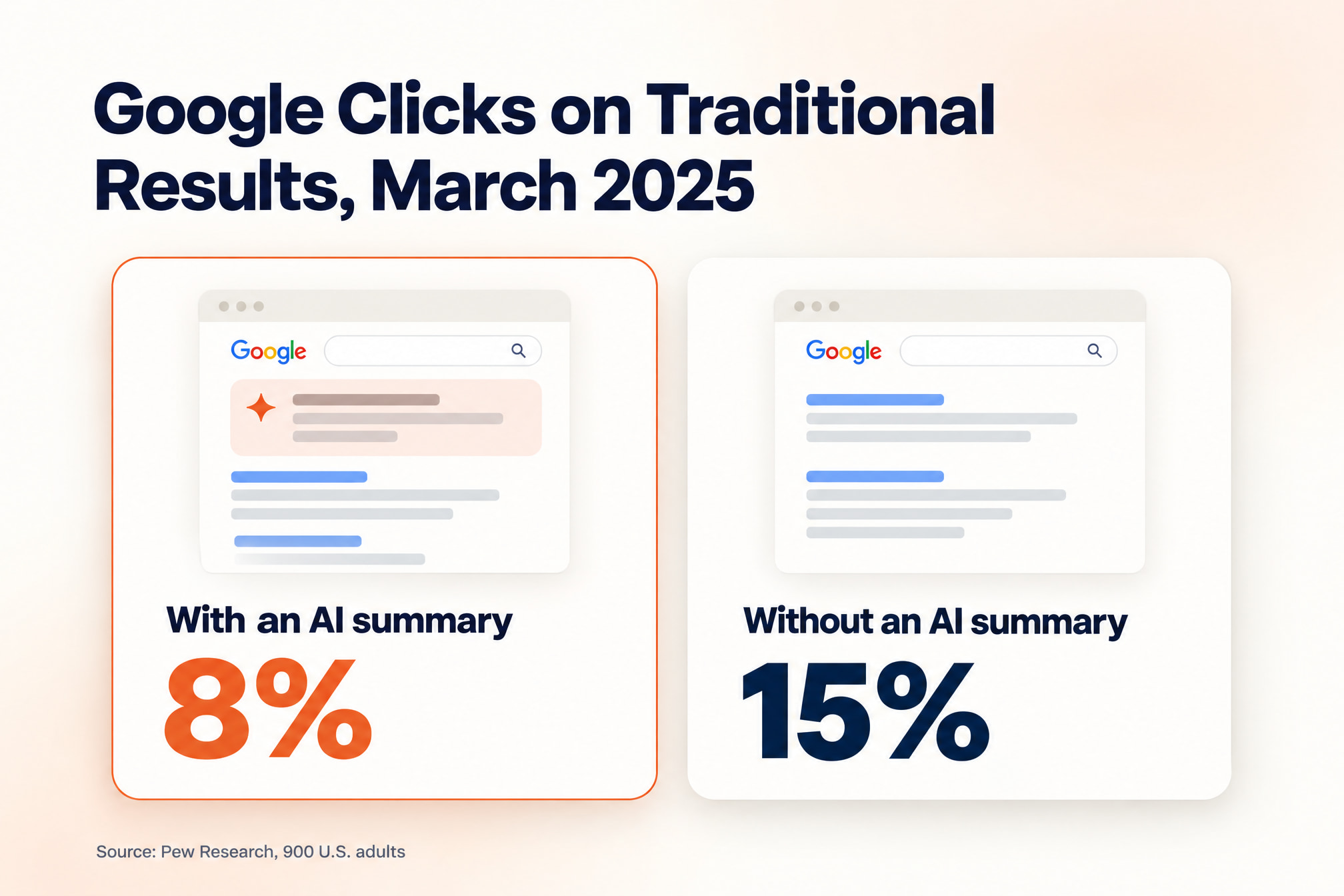
Start with search. Even when Google cites your page in an AI summary, readers rarely follow the link. Pew's study found users clicked a source link inside the summary in only about 1% of visits. Being named in Google's AI Overviews still builds recognition. It won't fill your analytics on its own.
Feeds are no easier. IAB and PwC put U.S. social media advertising revenue at $117.7 billion in 2025, up 32.6% year over year. Every organic post you share competes with that spend for the same scroll.
The good news is that your readers haven't gone anywhere. They've spread out. Edelman and LinkedIn's 2025 research studied what it calls hidden buyers, as distinct from the target buyers vendors usually pitch. Edelman found 63% of hidden buyers spend more than an hour a week reading thought leadership, nearly the same share as target buyers. In the same research, 95% of hidden buyers said strong thought leadership makes them more open to sales and marketing outreach.
That is what a distribution plan buys you. Visibility comes from showing up where those readers already are. Engagement comes from using the format each channel rewards. Return comes from measuring which channels move people toward a sale and putting more effort there.
Owned, Earned and Paid Channels Each Do a Different Job
Owned channels compound over time, earned channels lend credibility and paid channels buy speed. Many guides add a fourth group, shared channels, meaning organic social posts. These sit between owned and earned. The table below compares all four by what each gives you and what it costs.
| Channel type | Typical example | What it gives you | Main drawback | Who controls reach |
|---|---|---|---|---|
| Owned | Email newsletter | Reach that compounds | Slow to build | You |
| Shared | LinkedIn post | Free reach on a big platform | Rented audience | The platform |
| Earned | Press mention | Third-party credibility | Hard to predict | Other people |
| Paid | Sponsored post | Speed and targeting | Stops when spend stops | Your budget |
Owned Channels Are the Only Audience You Keep
Owned channels are your blog, website, email list and any community you run. Nobody can change an algorithm and take them away. Email lists and communities matter most. You hold the contact details and can reach people on your own schedule.
They are also where first-party data comes from, and most teams are still early on that. The Content Marketing Institute found 91% of B2B marketers collect first-party data. Yet half describe their strategy for it as exploratory (19%) or developing (31%). A newsletter signup on every post is the plainest place to start closing that gap.
Treat a LinkedIn following as half-owned. You built it, but the platform decides how many followers see each post. That's why every shared post should send some readers back to a channel you own.
Earned Channels Lend You Someone Else's Credibility
Earned reach is what other people give you, like shares, press coverage, newsletter mentions and links from other sites. You can't buy it or schedule it. You can make it more likely by publishing something worth citing. Think of an original number, a clear answer or a template people want to pass on.
Search counts here too. A featured snippet or a People Also Ask box is earned space on Google's own results page. Winning SERP features comes down to answering the question more clearly than the pages around you.
Communities are the other big source. Pew counts 26% of U.S. adults using Reddit, up from 18% four years earlier. Threads there and in industry groups are where people recommend what they've read. Show up as a member first. Links dropped into communities you never post in get ignored or removed.
Paid Channels Buy Speed for Posts Already Proven
Paid distribution puts a piece in front of a chosen audience today. The usual routes are search ads, sponsored social posts, newsletter sponsorships and creator partnerships. Creators are now a serious slice of that spend. IAB counted $37 billion in U.S. creator advertising in 2025 and now describes creators as a core media channel. For a niche B2B audience, sponsoring the one newsletter your buyers all read can beat a broad ad campaign.
For a small team, paid works best as an amplifier. Put money behind a post that already drew comments or replies organically. Skip the one nobody responded to. A boost multiplies whatever response a post already gets, including none.
Step 1: Find Where Your Audience Already Spends Time
Audience research for distribution should end with a short list of named places, not a persona slide. Your own customers are the fastest source. Ask your most recent ones where they first heard of you, which newsletters they open and whose posts they read. Add what your first-party data already shows, such as referrers in your analytics and the answers people give on signup forms.
Then check your list against the wider picture. In a survey run from February to June 2025, Pew found 84% of U.S. adults use YouTube, 71% use Facebook, 50% use Instagram and 37% use TikTok. Those are general consumer numbers. They tell you scale, not fit.
B2B and B2C audiences split sharply. B2B marketers rated LinkedIn (76%), email newsletters (54%) and speaking events or webinars (52%) the most effective channels for thought leadership in CMI's 2026 research. Consumer marketers see it differently. HubSpot found B2C marketers rank Instagram and Facebook highest for ROI, at 47.4% each, followed by YouTube at 43.9%.
Write the result as one sentence you can test. "Our buyers are operations leads at small agencies who read two industry newsletters and check LinkedIn at lunch." If you can't name the places, you're not ready to choose channels.
Step 2: Audit What You Already Have Before Making More
Your best distribution material is probably already published. An audit sorts existing posts by what they've earned so far, so you distribute proven pieces before writing new ones. Pull every post with its traffic, ranking, conversions and any links or mentions it picked up. Then sort each into one of four piles.
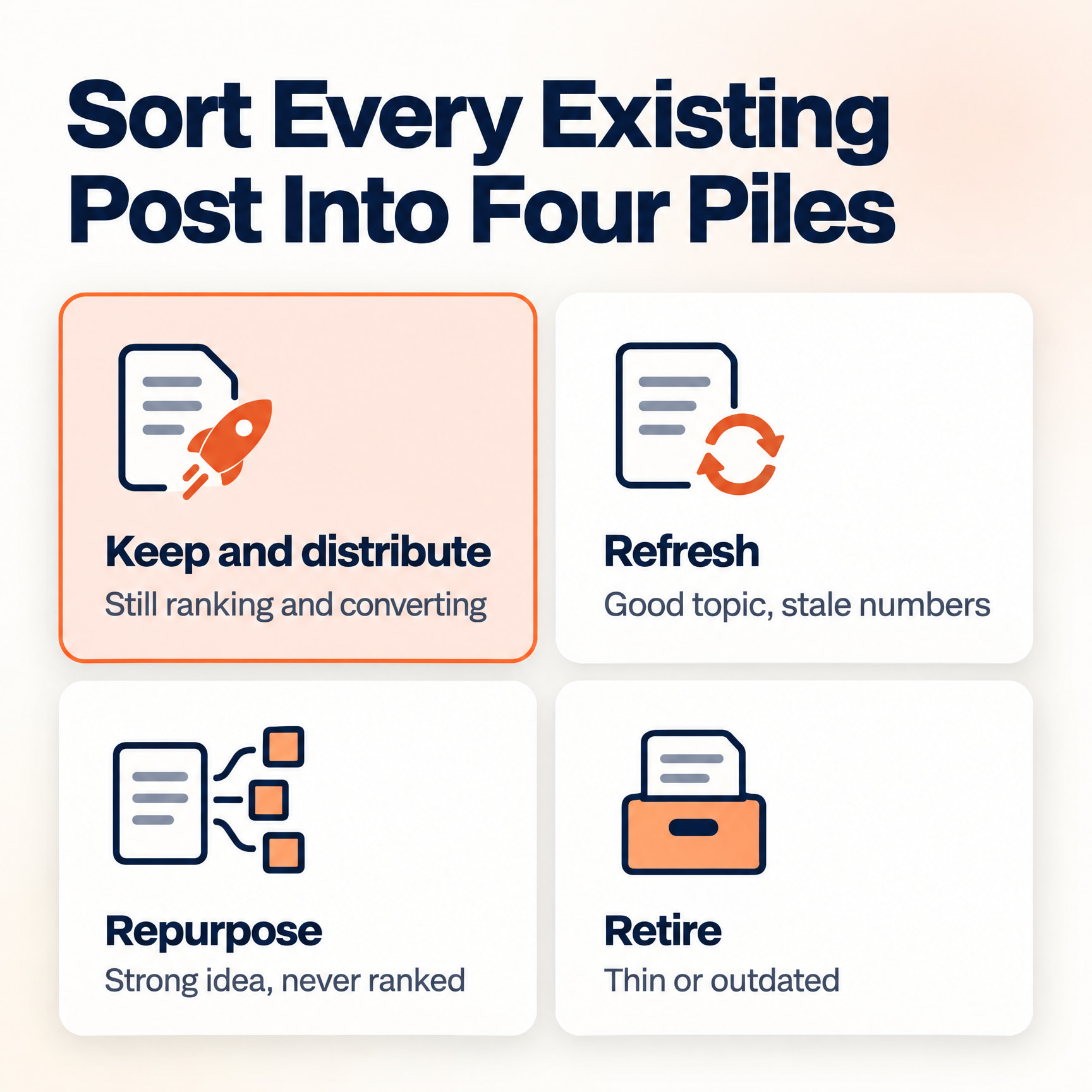
- Keep and distribute. Posts still ranking and converting. These go into the calendar first, cut into new formats.
- Refresh. Good topics with stale numbers, broken links or a weak opening. Update them, then distribute them as if new.
- Repurpose. Posts that never ranked but hold a strong idea, a useful table or a story. Pull that part out as a social post, a clip or a newsletter section.
- Retire. Thin or outdated posts nobody reads. Merge them into a stronger page or redirect them.
If the keep pile is short and the refresh pile is long, that's useful news. Your first month of distribution can run almost entirely on content you've already paid for.
Step 3: Choose Two or Three Channels and Match Formats to Each
Two or three channels run well will beat six run badly. A small team rarely has the hours for more anyway. Most B2B teams already spread wide. Over the prior 12 months, CMI found B2B marketers distributed content through organic social media (89%), company blogs (84%) and email newsletters (71%). Being present everywhere is normal. Being consistent somewhere is the edge.
Pick your owned home base first, usually your blog plus an email newsletter. Then add one or two shared or earned channels from your Step 1 list. Choose the format along with the channel. The table below pairs common channels with a format worth testing and a sensible first piece.
| Channel | Format to test | Good first piece | Effort |
|---|---|---|---|
| Blog | Researched long-form post | A refreshed top post | High |
| Email newsletter | Short essay with one link | The post's main argument | Medium |
| Text post or carousel | One finding with context | Low | |
| X | Thread | Numbered takeaways | Low |
| YouTube | Short vertical video | A quick explainer | Medium |
| Communities | Helpful reply | An answer to a live question | Low |
Video deserves a serious look, even for text-first teams. In HubSpot's 2026 research, marketers named three video formats as their top performers for ROI. Short-form video led (49%), then long-form video (29%), with livestreaming third. You don't need a studio. Clips cut from a webinar, or a founder talking through one chart, are enough to start.
Step 4: Write Once, Then Rewrite the Copy for Every Platform
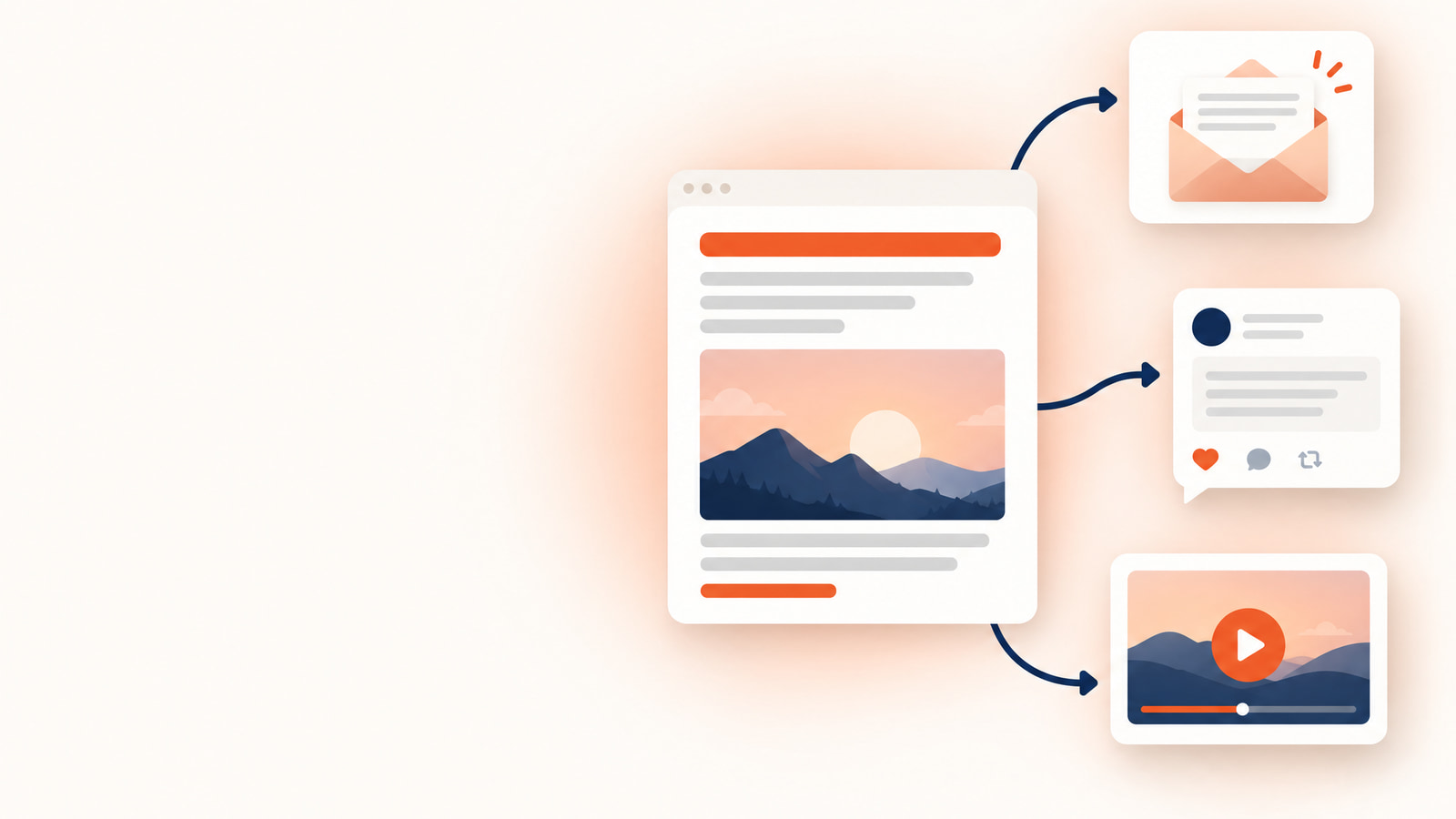
Repurposing works only when each version is rewritten for its platform, not pasted in. The same idea needs a different opening, length and call to action on LinkedIn than in an inbox. Plan the cuts in your content brief before drafting. Then the post contains the pieces each format needs.
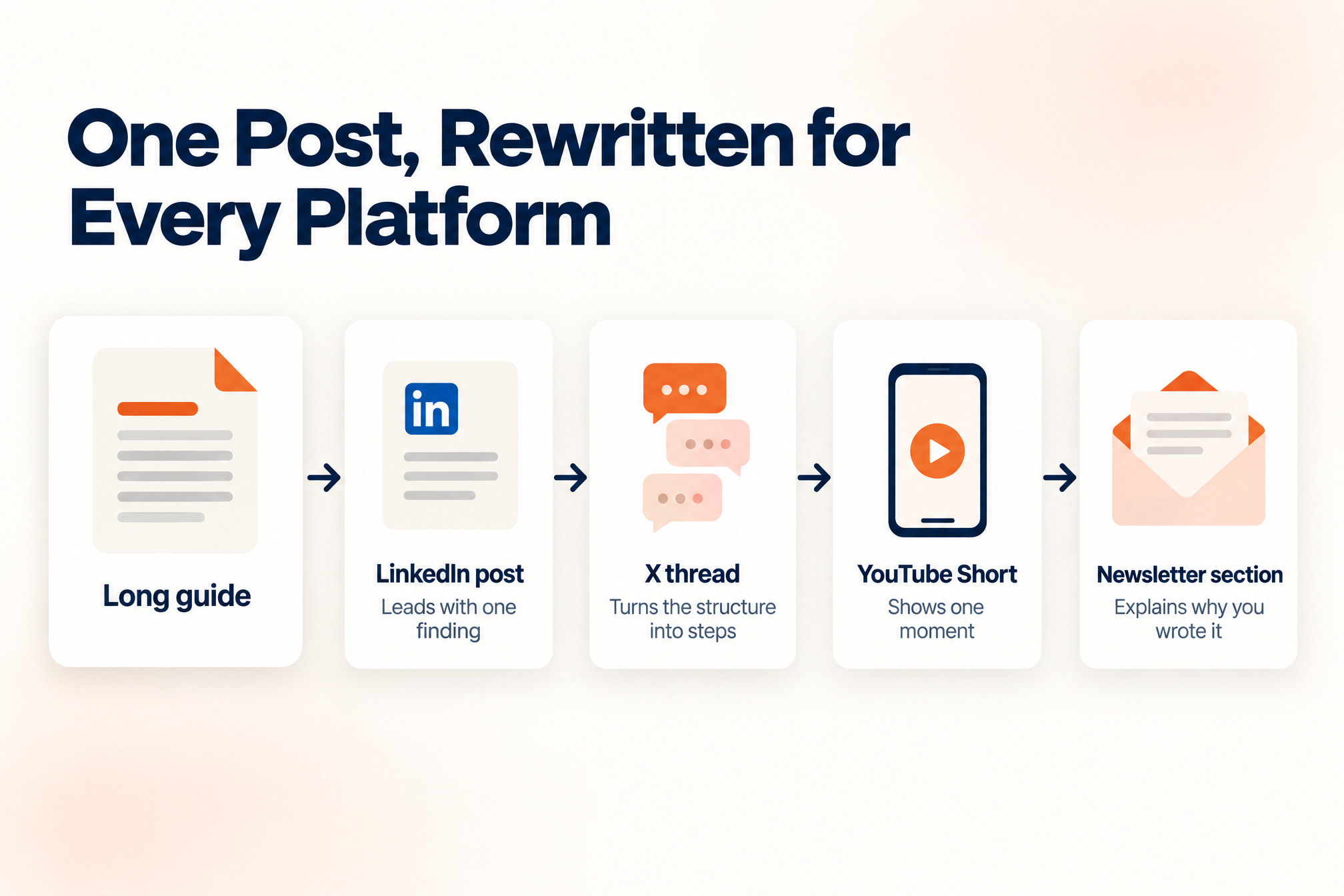
Here is how one post travels. Say you publish a long guide on pricing a design retainer. It has a three-tier pricing table and a story about a client who kept asking for "one small change".
The LinkedIn Post Leads With One Finding
The LinkedIn version takes the single most useful point and builds a few short paragraphs around it. Open with a line that works before the "see more" cut. For example: "Hourly billing punishes you for getting faster." Give the reasoning, then add the pricing table as an image. Put the link in the post or the first comment, and check which gets more clicks for your account.
The X Thread Turns the Structure Into Steps
The X thread follows the post's skeleton. The first post states the payoff: "How to price a retainer so scope creep costs the client, not you." Each following post carries one numbered step. The last post holds the link and one line on what the full guide adds.
The YouTube Short Shows One Moment
The short video needs one visual idea, not a summary of the whole guide. Walk through the three tiers on screen, or tell the "one small change" story with the table behind you. Write the title the way a viewer would search for the problem. Point to the full guide in the description.
The Newsletter Section Explains Why You Wrote It
The newsletter version is where your voice does most of the work. Subscribers chose to hear from you, so write to one of them. Say why you wrote the guide and what surprised you in the research. Name the tier most readers should start with. Then link to the post once, clearly.
Facebook and Instagram follow the same rule. For a consumer audience, the Instagram version could be a carousel of the pricing table, one tier per slide. The Facebook version could ask a group how they price their own work. AI tools can draft these adaptations fast. HubSpot found 80% of marketers use AI for content creation. Let it produce the first cut, then edit every version until it sounds like you.
Every cut inherits the source post's facts, so the source has to be right. Full disclosure, we make Serpjoy. It reads 70 to 100 sources for each post and pairs every statistic with its source. Whatever you use, start repurposing from a post where each number is cited.
Step 5: Put It on a Calendar With a Realistic Frequency
Steady cadence matters more than volume, and buyers notice it. Edelman and LinkedIn found 79% of hidden buyers are more likely to champion a vendor in an RFP if it consistently publishes quality thought leadership. One post a week, distributed properly for two weeks, beats three posts a week that go out once and vanish.
The calendar below spreads one post across two weeks. Copy it and swap in your own channels.
| Day | Channel | What goes out |
|---|---|---|
| Day 0 | Blog | Publish the post |
| Day 0 | Founder shares the main finding | |
| Day 2 | Email newsletter | Why you wrote it |
| Day 3 | X | Thread of the steps |
| Day 5 | YouTube | Short video on one moment |
| Day 7 | Communities | Answer a live question |
| Day 9 | Second angle on the table | |
| Day 14 | All channels | Review the numbers |
Start the next post a week later on the same rhythm and the two calendars overlap. Each channel gets a steady flow without anyone posting daily. If it's still too much, drop a channel before you drop the cadence.
Step 6: Measure Each Channel Against Its Own KPI
Each distribution channel needs its own KPI, because one sitewide traffic number hides which channel is doing the work. A LinkedIn post that sends few visits but draws comments from buyers is doing its job. Judge it on clicks alone and you'll cut the wrong channel. The table below gives each channel one primary metric.
| Channel | Primary KPI | What it tells you |
|---|---|---|
| Blog and search | Assisted conversions | Whether readers later buy |
| Email newsletter | Click rate | Whether issues earn action |
| LinkedIn and X | Comments and saves | Whether the idea landed |
| YouTube | Watch time | Whether viewers stayed |
| Communities | Replies and referrals | Whether members found it useful |
| Paid | Cost per lead | Whether the spend paid back |
Search needs one extra measure now. With fewer clicks when AI summaries appear, track impressions and whether your pages are cited in AI answers, alongside clicks. A page can grow its reach while its traffic stays flat.
Review every channel monthly and make one call for each: keep it, change the format or cut it. Give a new channel three months before judging it, since an audience takes time to form. Then connect the channels that survive to revenue, the same way you would measure content marketing ROI for the blog itself.
Quick Answers on Content Distribution
What Are the Four Types of Content Distribution?
Owned, shared, earned and paid. Owned covers channels you run. Shared covers organic social posts. Earned covers mentions and coverage others give you. Paid covers ads and sponsorships.
How Many Channels Should a Small Team Use?
Start with two or three. Use one owned home base, such as your blog and newsletter, plus one or two channels your audience already uses. Add another only when those run on a steady schedule.
How Long Should You Keep Distributing One Post?
Plan at least two weeks of distribution for each post. Put evergreen posts back on the calendar whenever you refresh them.
What Is the Difference Between Content Strategy and Distribution Strategy?
Content strategy decides what to create and why. A content distribution strategy decides where, when and in what format each piece is published, shared and promoted.
Fill In This One-Page Plan Before Your Next Post Goes Live
Write the plan for the next post you publish, before you publish it. Keep each line to a sentence.
- Audience. Who it's for, and the named places they already read.
- Channels. Your owned home base plus up to two others.
- Formats. One format per channel, planned in the brief.
- Cadence. The day each version goes out over two weeks.
- KPIs. One metric per channel, reviewed monthly.
The plan only spreads what the post contains, so start from one with every number sourced. Serpjoy writes those in your voice, and the first post costs $1 with no subscription.
Pin the plan next to the draft. If a line is still blank on publish day, the post isn't ready.