


A content brief is a short document that tells a writer what to produce, who it's for and why it exists. A complete content brief covers the goal, target audience, primary keyword and search intent, outline, word count, tone, links, call to action and deadline. Poor briefs cost real money: respondents to the 2021 BetterBriefs global survey of marketers and agency staff estimated that 33% of marketing budget is wasted on poor briefs and misdirected work.
Most rewrites start before the writer opens a blank doc. Someone asks for "a post about onboarding" and gets one, just not the one they pictured. The fix is dull and it works: decide what you want and write it down first.
What Is a Content Brief?
A content brief is a documented set of requirements that guides a writer on what to write, for whom, and what the piece should achieve.
No standards body defines the term. Most of the common wording comes from software vendors' blogs, so don't lose sleep over the exact phrasing.
What matters is the job it does. A brief is the blueprint for one piece of content. It turns a loose request into decisions the writer no longer has to guess at.
It's also the single source of truth when people disagree later. The editor, the SEO lead and the client all check the same page instead of their memories.
The difference between a vague request and a strategic content brief looks like this:
| Field | Vague request | Strategic content brief |
|---|---|---|
| Topic | "Something on email marketing" | Welcome email sequences for SaaS free trials |
| Audience | "Small businesses" | Founders running a free trial with no onboarding emails yet |
| Goal | "Get traffic" | Rank for the primary keyword and send readers to the onboarding checklist |
| Keywords | None | Primary: welcome email sequence. Secondary: onboarding emails, trial nurture emails |
| Length | "Not too long" | A word count range taken from the ranking pages |
| Deadline | "ASAP" | Draft Thursday, edits Monday, publish Wednesday |
Simple test. If the writer has to email you a question before starting, the brief missed something. And those gaps cost more than most teams expect.
Why Content Briefs Cut Revisions and Wasted Budget
Content briefs reduce revision rounds, speed up production and keep writers, editors and stakeholders aligned on one shared plan.
The people who write briefs think theirs are fine. In the 2021 BetterBriefs global study, 78% of marketers said their briefs give clear strategic direction, while only 5% of agencies agreed.
Those were briefs handed to creative agencies. The lesson still applies to any writer. The person who wrote the brief knows what they meant. The person reading it only knows what's on the page.
Nobody has hard data on how many revision rounds a clear brief saves. Practitioners consistently report less back-and-forth, and the logic holds up. Writers produce more on-target first drafts when they understand the audience and the purpose.
In practice, a good content brief gets you these five things:
- Fewer rewrites. The angle is settled before the first draft exists.
- Faster production. The writer spends the hours writing instead of guessing.
- Team alignment. The editor and client approve a plan, so nobody rejects a finished draft for a reason they could have raised earlier.
- Brand consistency. Tone and style guide rules travel with every piece.
- Measurable ROI. Each piece ties to a goal you can check.
Briefs feel like overhead until you count the drafts they prevent. So what goes in one?
What a Content Brief Includes: 9 Essential Elements
A content brief includes nine essential elements: goal and KPIs, target audience, search intent, keywords, outline, word count, tone, links with a meta description, and the CTA with deadlines.
You can add fields. Cut any of these nine and the gap usually comes back as a rewrite.
Here are the nine elements, the question each answers for the writer, and a sample entry:
| Element | Question it answers | Sample entry |
|---|---|---|
| 1. Goal and success metrics | Why does this piece exist? | Drive trial sign-ups from organic search |
| 2. Target audience and journey stage | Who reads it, and what do they already know? | Ops managers comparing tools, mid-funnel |
| 3. Search intent | What does the searcher want from this query? | Learn the steps, see an example |
| 4. Primary and secondary keywords | Which terms should it rank for? | Primary: content brief. Secondary: content brief template |
| 5. Suggested title and outline | What shape should it take? | Working title plus H2 and H3 headings |
| 6. Word count and format | How long, and in what format? | Guide format, range set from ranking pages |
| 7. Tone, brand voice and style guide | How should it sound? | Plain, direct, no jargon, follow the house style guide |
| 8. Links and meta description | What does it connect to? | Named internal links, primary sources, draft meta description |
| 9. CTA, deadline and approval | What happens next, and when? | Book a demo. Draft Thursday, editor sign-off Monday |
Start with the goal. Every other field in the brief depends on it.
Goals, Objectives, and Success Metrics
The goal section of a content brief states why the piece exists and names the success metric, or KPI, that will show whether it worked.
Having a strategy and briefing a writer are two different things. According to CMI's 2026 B2B research, 97% of B2B marketers say they have a content strategy. That number measures strategy. It tells you nothing about whether a single post carries a goal the writer can see.
Write the goal as one sentence with a verb. "Raise awareness" is a wish. "Rank on page one for content brief template and send readers to the template" is a goal.
Then pick one primary KPI. Organic sessions, sign-ups from the post, demo bookings or newsletter subscribers all work. Choose the one that fits the reader's funnel stage.
Tie the call to action to that KPI. If the metric is trial sign-ups, the CTA asks for a trial. Obvious. Yet plenty of posts still end with "follow us on LinkedIn."
A goal only works if you know who you're trying to move. That's the audience field.
Target Audience, Buyer Persona, and Search Intent
The target audience section of a content brief names the buyer persona, their pain points, their stage in the customer journey and the search intent behind the query.
Buyer Persona and Journey Stage
A buyer persona in a content brief describes one specific reader: their job, what they already know and the problem that sent them searching.
This is where briefs go soft. Only 38% of UK agencies say they're clear on the target audience in client briefs, according to Marketing Week's report on the IPA best practice guide. Most agencies, then, start work unsure who they're writing for.
In-house teams struggle too. In CMI's 2024 survey, 57% of B2B marketers named creating the right content for the audience as a challenge. The CMI 2025 B2B trends survey put that figure at 40%. Progress, though a big share of teams still admit they miss.
Replace "small businesses" with a person. Write their role, their main pain point and what they should do after reading. Then name the journey stage, because a top-of-funnel reader wants a template and a bottom-of-funnel reader wants pricing.
Search Intent Sets the Format
Search intent is the reason behind a query, and a content brief should label it as informational, commercial or transactional.
Check the ranking pages before you set it. If the top results are long guides with templates, a short opinion piece won't compete, however good it is.
Intent leads straight into the keyword decisions.
SEO Requirements: Keywords, Meta Description, and Links
The SEO section of a content brief lists the primary keyword, secondary keywords, a draft meta description, and the internal and external links the writer must include.
Keywords tell the writer what to cover. They aren't a quota. Google's guidance on creating helpful content says its ranking systems are designed to prioritize helpful, reliable information made to benefit people over content made to manipulate search rankings. It also lists self-assessment questions, such as whether content is original and covers a topic fully.
A brief that names the audience and purpose makes people-first content the default. That's the strongest SEO argument for briefs.
Primary and Secondary Keywords
A content brief should set one primary keyword per piece, plus a short list of secondary keywords and related questions.
Put the primary keyword in the title, the first paragraph and one H2. Then leave the writer alone. Asking for the keyword "in every paragraph" makes the post worse to read and helps nobody.
Before you lock the format, check which SERP features appear for your keyword. A featured snippet, a video carousel or an AI Overview each changes what the brief should ask for.
Meta Description and Links
A content brief should include a draft meta description, the internal links with suggested anchor text, and the external sources the writer may cite.
The meta description tells the writer what promise the page makes in search results. Name preferred external sources, primary ones where possible: official documentation, government data, original research. A brief that asks for "some stats" gets whatever the writer finds first.
With the SEO decisions made, the writer needs a shape.
Outline, Headings, Word Count, and Tone
The structure section of a content brief gives the writer a suggested title, an H2 and H3 outline, a word count range, the format and the tone of voice.
Suggested Title and H2/H3 Headings
A suggested title and draft headings show the writer the order of ideas and the question each section answers.
Write headings as claims or questions. "Benefits" is a label. "Briefs Cut Revision Rounds" tells the writer what to prove.
Leave room, though. An outline is a roadmap, and the writer can take a better route if they find one.
Word Count Guidance
Word count in a content brief should come from what already ranks for the query and be set as a range.
For a reference point, Orbit Media's 2025 survey of 808 bloggers found the average blog post was 1,333 words. That's an average across every topic, so treat it as a sanity check. Your keyword's ranking pages are the real benchmark.
Tone, Brand Voice, and Style Guide
The tone section of a content brief describes the brand voice in plain words and links to the style guide.
"Friendly but professional" tells a writer nothing. Three adjectives, a list of words to avoid and links to two published posts that sound right tell them plenty.
That's everything that goes in. Putting it together shouldn't take a day.
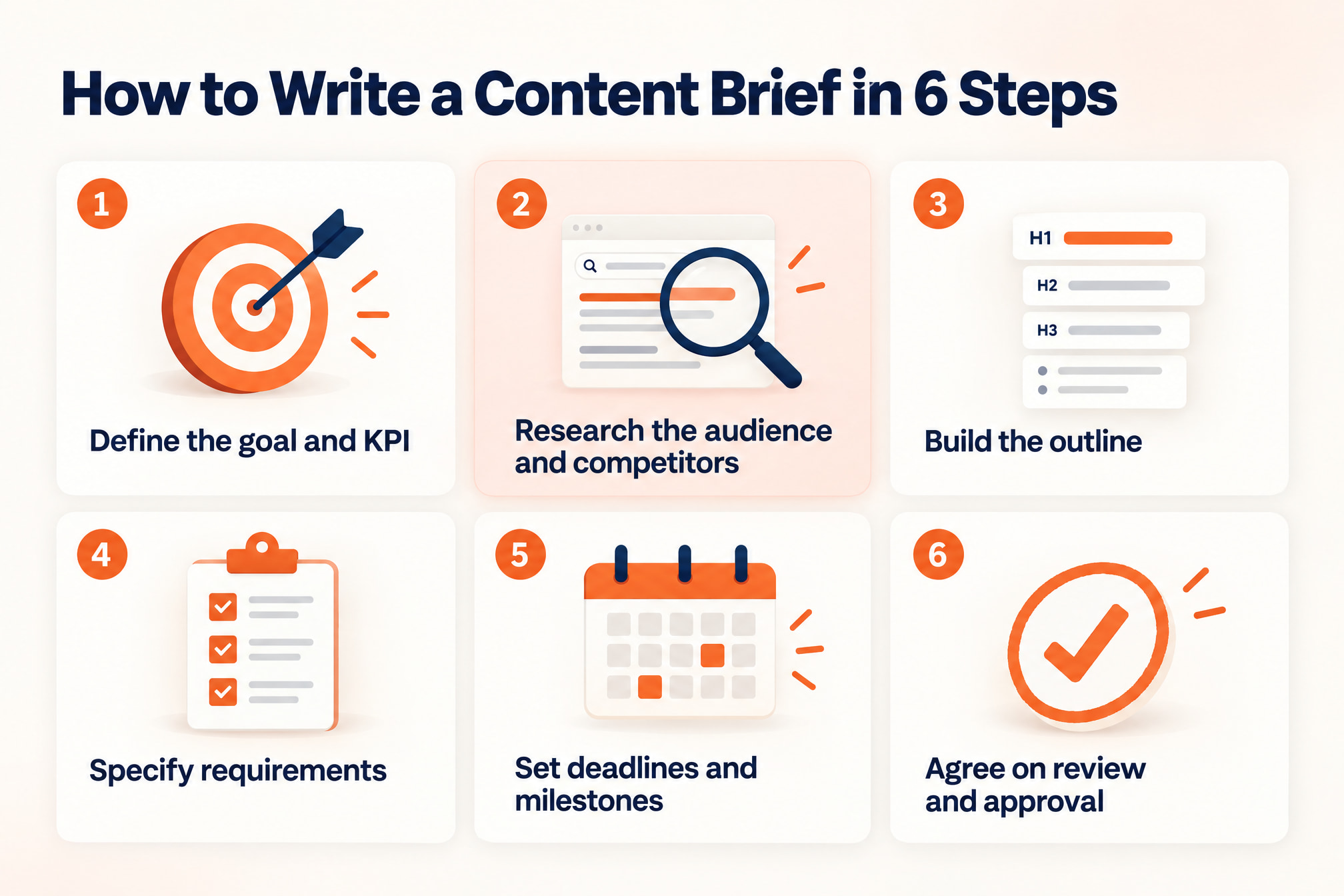
How to Write a Content Brief in 6 Steps
Writing a content brief takes six steps: define the goal, research the audience and competitors, build the outline, specify requirements, set deadlines, and agree on the review workflow.
The draft itself already takes real time. Orbit Media's 2026 Blogger Survey of 1,042 content marketers puts the average blog post at 3 hours 20 minutes, down from a peak of 4 hours 10 minutes in 2022. Every rewrite a vague brief triggers spends those hours again. A brief is cheap next to a second draft.
Follow these six steps in order:
- Define the goal and KPI. One sentence, one metric, one CTA.
- Research the audience and competitors. Read the top-ranking pages for the primary keyword. Note what they all cover, what they skip, and the questions searchers ask. Google's People Also Ask questions are a quick source of headings and FAQ items.
- Build the outline. Suggested title, H2s, H3s and the content gaps you plan to fill.
- Specify requirements. Keywords, word count range, tone, links, sources, meta description and visuals.
- Set deadlines and milestones. Outline approval, first draft, edits and publish date.
- Agree on review and approval. Name who signs off and in what order, so feedback doesn't arrive from everyone at once.
Step two is where a brief earns its keep. If every ranking page answers the same questions and none includes a worked example, the example is your content gap. Put it in the brief as a requirement.
Templates help teams standardize the process. Use the same one for every piece and each brief gets faster to write.
Three Content Brief Examples and a Template to Copy
The content brief examples below show filled-in briefs for a blog post, a video script and a listicle, followed by a reusable content brief template.
The details are illustrative. Swap in your own product, audience and keywords.
Example 1: Blog Post Brief
A blog post content brief for an SEO guide fits the keyword, intent, outline and CTA on one page:
- Working title: How to Write a Welcome Email Sequence for a Free Trial
- Goal and KPI: Rank for the primary keyword. KPI: onboarding checklist downloads.
- Audience: SaaS founders with a free trial and no onboarding emails. Mid-funnel.
- Intent and keywords: Informational. Primary: welcome email sequence. Secondary: onboarding emails, trial nurture emails.
- Outline: What a welcome sequence is, which emails to send, timing, examples, mistakes, FAQ.
- Word count and tone: Range from the top-ranking pages. Plain and practical, no hype.
- Links, CTA and deadline: Internal links to the pricing page and onboarding guide. CTA: download the checklist. Draft Thursday, edits Monday.
Example 2: Video Script Brief
A video script content brief adds a hook and on-screen elements to the usual goal and audience fields:
- Working title: Set Up Your First Automation in the Dashboard
- Goal and KPI: Cut setup support tickets. KPI: tickets tagged "automation setup."
- Audience: New, non-technical customers in their first week.
- Hook: Open on the finished automation running, then rewind.
- Script outline: The problem, each setup step as its own scene, the result, the CTA.
- Tone and visuals: Calm. Screen recording with captions and brand colors.
- CTA and deadline: Link to the help doc. Script approved before recording day.
Example 3: Listicle Brief
A listicle content brief defines the selection criteria and the format each list item follows:
- Working title: Content Brief Mistakes That Cause Rewrites
- Goal and KPI: Grow newsletter sign-ups from organic search.
- Audience: In-house marketers and freelance writers. Early-funnel.
- Intent and keywords: Informational. Primary: content brief mistakes. Secondary: bad content brief, content brief tips.
- Item format: Heading, bad example, good example, one-line fix.
- Tone: Direct, a little dry, follow the style guide.
- CTA and deadline: Subscribe for the template. Outline approval first, then the draft.
To see what finished, briefed work looks like, browse Serpjoy's example blog posts.
A Reusable Content Brief Template
A reusable content brief template is a fixed set of fields your team fills in for every piece of content.

Copy these fields into a doc or your project tool. Keep the fields fixed and the answers short.
| Field | What to write |
|---|---|
| Working title | One suggested title containing the primary keyword |
| Goal and KPI | One sentence, one metric |
| Target audience | Persona, pain point, journey stage |
| Search intent | Informational, commercial or transactional, plus what ranks now |
| Keywords | Primary keyword, secondary keywords, related questions |
| Outline | H2 and H3 headings, content gaps to cover |
| Word count and format | Range from ranking pages, format, visuals |
| Tone and voice | Three adjectives, words to avoid, style guide link |
| Links and sources | Internal links with anchors, external sources, meta description |
| CTA | One action |
| Deadlines and approval | Milestones, reviewers, sign-off order |
A template only helps if the answers are specific. Which brings us to the ways briefs go wrong.
Content Brief Mistakes That Send Drafts Back
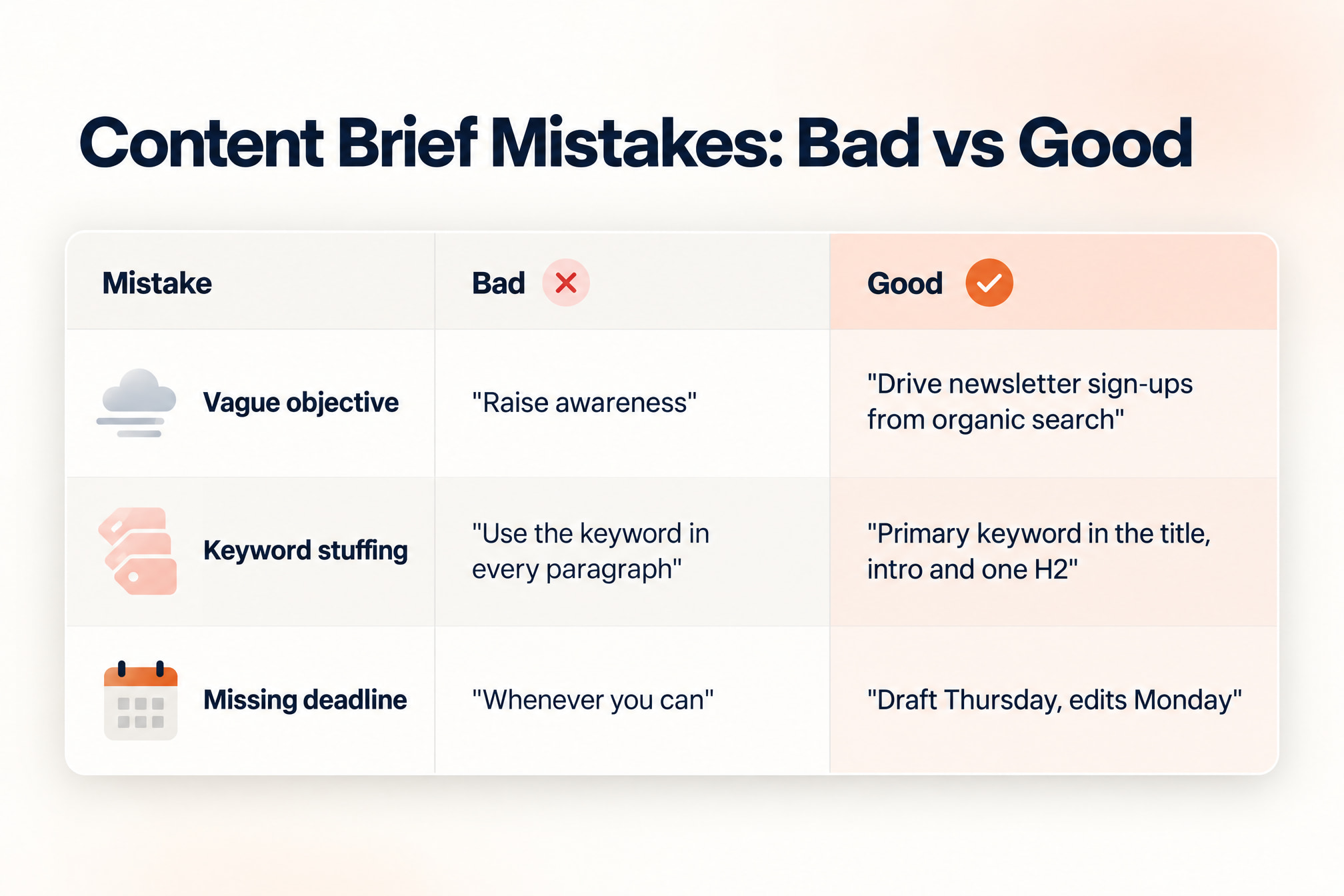
The most common content brief mistakes are vague objectives, a generic audience, contradictory guidance, keyword stuffing and overly prescriptive outlines.
Marketers know this hurts. UK marketers estimate that 26% of their marketing budget is wasted on poor briefs and misdirected work, according to the IPA and BetterBriefs UK study of 508 respondents. That money is gone before anyone notices the brief was wrong.
Here's each mistake with a bad and a good version:
| Mistake | Bad | Good |
|---|---|---|
| Vague objective | "Raise awareness" | "Drive newsletter sign-ups from organic search" |
| Generic audience | "Marketers" | "Freelance writers who keep getting revision requests from agencies" |
| Contradictory guidance | "Keep it short" plus a sprawling outline | A word count range with an outline sized to fit it |
| Keyword stuffing | "Use the keyword in every paragraph" | "Primary keyword in the title, intro and one H2" |
| Overly prescriptive | Every sentence scripted | Headings and key points set, writer picks the examples |
| Missing deadline | "Whenever you can" | "Draft Thursday, edits Monday" |
Content Brief Best Practices
The best content briefs are short, specific and written for someone who has never seen your product.
If a freelancer can follow it cold, your own team certainly can. When writers keep asking the same question, add a field to the template that answers it.
Quick win for today: open your last brief and check whether it names a KPI and a journey stage. If not, add both before the next one goes out.
Who Writes Content Briefs and How They Differ From Creative Briefs
Content briefs are usually written by a content strategist or SEO specialist and used by writers, editors, subject matter experts and clients.
Each role touches the brief differently:
| Role | What they do with the brief |
|---|---|
| Content strategist | Sets the goal, audience and angle |
| SEO specialist | Adds keywords, search intent, competitor gaps and links |
| Writer or freelancer | Drafts against it and flags gaps early |
| Editor | Checks the draft against the brief instead of personal taste |
| Subject matter expert | Supplies facts and reviews accuracy |
| Client or stakeholder | Approves the brief before drafting starts |
AI-Assisted Briefs Still Need a Human
AI tools can draft a content brief quickly, and a human still needs to set the goal, check the sources and approve the angle.

Tools help. Thinking helps more. CMI's B2B content marketing trends research found 61% of B2B marketers say their content strategy got more effective over the past year. Of that group, 74% credited refining their strategy and 51% credited new technology.
Better thinking beat better software. Use AI to gather ranking pages and rough out the outline. Keep the goal and the final sign-off with a person.
Serpjoy builds that research into every post. It studies what already ranks, reads 70 to 100 sources on the live web and pairs each statistic with its source. Then it asks the author two or three questions where their experience matters.
Content Brief vs Creative Brief
A content brief guides a single piece of content such as a blog post or video, while a creative brief guides agency campaign work such as ads or brand concepts.
The BetterBriefs research looked at creative briefs. Its lesson carries straight over to content: the brief writer always rates their own brief clearer than the reader does.
Quick Answers About Content Briefs
How do you make a content brief?
You make a content brief by defining the goal, researching the audience and competitors, building an outline, specifying requirements, setting deadlines and agreeing on a review process. The six-step section above covers each one.
What is an example of a brief?
An example of a content brief is a one-page document listing a working title, goal, target audience, primary keyword, outline, word count, tone, links, CTA and deadline. The three filled-in examples above show it for a blog post, a video script and a listicle.
What is an example of a creative brief?
A creative brief example is an agency brief for an ad campaign that sets the business objective, target audience, key message and deliverables. It covers campaign work rather than a single article.
Does a content brief help SEO?
A content brief helps SEO by fixing the primary keyword, secondary keywords and search intent before drafting starts. It also defines the audience, which keeps the piece focused on helping people.
Write Your Next Content Brief Before the Next Draft
A content brief prevents rewrites by settling the goal, audience, keywords, outline and deadline before anyone writes a word.
If you only fix four fields, fix these in order: goal, audience, keyword and intent, outline. Get those right and the rest is detail. Word count, tone and links matter, but they rarely cause a full rewrite on their own.
Today, pick the next piece on your calendar and fill in the goal, KPI and audience fields from the template above. Takes ten minutes. Over the next week, compare revision rounds on briefed pieces against your last few unbriefed ones. If the count doesn't drop, the brief is still too vague, so tighten the audience first.
If you want those briefed posts cited in AI answers as well as ranking, read up on how to optimize for Google's AI Overviews.
A brief is the cheapest draft you'll ever write. Write it first.