


Evergreen content is content that stays relevant and useful for years after it's published, like the evergreen tree that keeps its leaves all year. That durability is now what wins search. In Ahrefs' updated study from late 2024, the average #1-ranking page is five years old. Old pages only keep winning when someone updates them with substance, not a new date.
Evergreen Content Is Built to Stay Useful for Years, Not Weeks
Evergreen content answers a question that doesn't expire. People searched "how do I write a cold email" five years ago, and they'll search it five years from now. Nobody will search "what changed in this week's Google update" next spring.
Merriam-Webster defines evergreen as "retaining freshness or interest," with "perennial" as its one-word gloss. Its second sense is "universally and continually relevant." That phrase works as a test for any post you plan. If the answer will still hold for most readers in three years, the topic is evergreen.
You'll also see it called timeless content or perennial content. Same idea. Typical examples are how-to guides, definitions, beginner guides and answers to problems your customers keep having. News, event recaps, trend reactions and "stats for 2026" roundups are not evergreen, however good they are.
Evergreen doesn't mean untouched. A guide to a tool's settings goes stale when the tool changes. The topic stays evergreen, but the page still needs care. That's the part most teams skip, and it's where most of the traffic is lost.
Timely Content Spikes and Fades While Evergreen Pages Build
News and trend posts collect most of their traffic in the first few days, while evergreen posts collect visits slowly and keep collecting them. Google's ranking systems treat the two differently.
On November 3, 2011, Google announced a freshness ranking change that it said impacts roughly 35 percent of searches. The system decides when a query needs fresher results. It targets four kinds of query: recent events, hot topics, regularly recurring events and frequently updated topics. News, trend and seasonal posts compete inside those queries. Evergreen posts mostly sit outside them, where a newer date isn't what the searcher is asking for.
Here's how the four types compare.
| Evergreen | News | Seasonal | Trending | |
|---|---|---|---|---|
| Example topic | How to write a cold email | A new Google update | Black Friday email ideas | A viral meme format |
| Traffic pattern | Steady, builds over time | Sharp spike, fast drop | Yearly spike | Spike, then nothing |
| Useful life | Years | Days | Weeks, every year | Days to weeks |
| Upkeep | Review every 6 to 12 months | None after it fades | Refresh before the season | None after it fades |
| Best job | Search traffic and leads | Social reach | Timed campaigns | Brand visibility |
Timely posts have a place. They get shared, and they give you something to say this week. But a small team with limited writing time should spend most of it on evergreen pages, and link the timely posts back to them.
Old Pages Win Search, and a Few Posts Carry the Whole Blog
Most of a blog's search traffic comes from posts published months or years earlier, and a small share of those posts does most of the work.
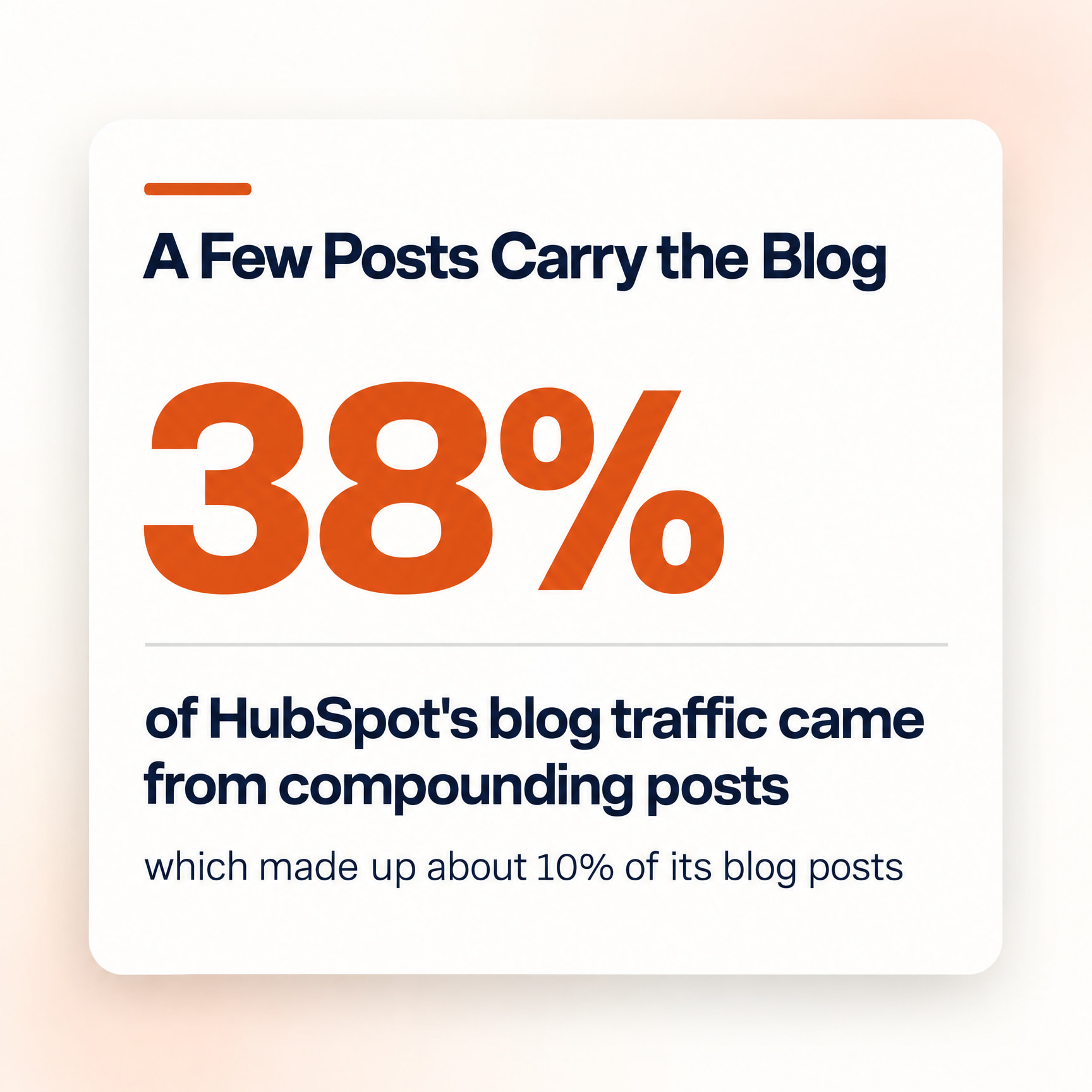
In an analysis from around 2015 and 2016, HubSpot found that compounding posts made up about 10% of its blog posts. Those posts, whose search traffic grows over time, brought in 38% of total blog traffic. The same analysis found 76% of monthly blog views came from posts published before that month.
Google's top results skew old too. In Ahrefs' late-2024 study, 72.9% of top-10 pages are more than three years old. In 2017 the average #1 page was two years old. Now it's five.
New pages have a harder road. Ahrefs' data shows only 1.74% of newly published pages reached Google's top 10 within a year. In 2017 it was 5.7%.
A new post competes against pages that have had years to collect backlinks and get refined. Treat every evergreen post as a multi-year project, not a launch.
One Compounding Post Does the Work of Six, Which Changes the ROI Math
A single compounding post matched the traffic of about six regular posts in HubSpot's analysis. You pay for it once, then it keeps bringing visits for as long as it ranks. The cost per visit falls every month.

The leads followed the same pattern. HubSpot found 92% of its monthly blog leads came from posts published before that month. Last month's writing wasn't paying the bills. The back catalog was.
Publishing more is the usual response to a quiet blog, and it rarely works. Ahrefs' 2023 study of about 14 billion pages found that 96.55% get zero traffic from Google. In Orbit Media's 2026 survey of 1,042 content marketers, only 13.9% said their blog gets "strong results." That's a record low, six points below the previous 12-year low.
Volume without durability just adds pages to that 96.55%. This is also why a fair read of content marketing ROI looks at years, not quarters.
Evergreen pages build authority too. When a reader finds the same clear, cited answer from you every time they search a topic, your site becomes their reference. Other writers find it the same way, and they link to it.
Good Evergreen Topics Come From Questions Customers Keep Asking
Your support inbox is a better topic list than any trend report. The questions customers ask every year, in the words they type into a search box, are the ones worth writing. Check each candidate against this list before you commit a writer to it.
- Flat or recurring demand in Google Trends. Look at five years of data. A steady line, a gentle rise or a repeating yearly pattern is good. A single spike is a trend.
- Real search volume in your keyword tool. Low volume is fine if the people searching are your buyers.
- It already shows up in your inbox. Sales calls, support tickets and onboarding questions are the best keyword research you own.
- The answer won't change next quarter. If the core advice depends on a pricing change or a product launch, it's timely.
- Related questions appear in Google's results. The questions in Google's People Also Ask box show what searchers want answered next.
- You can beat what ranks now. Read the top five results. If you can't add a clearer answer, better sources or your own experience, pick another topic.
Topics tied to one tool's interface pass most of these tests but fail the last-for-years one. They're still worth writing. Just budget for more frequent updates.
Seven Evergreen Formats That Last, With Titles You Can Adapt
How-to guides, tutorials, FAQs, listicles, definitive guides, infographics and videos are the seven formats that hold their value longest. Beginner guides belong in the same family, because there are always new beginners. The table pairs each format with a sample title you can adapt.
| Format | Example title | Why it lasts |
|---|---|---|
| How-to guide | "How to Write a Cold Email That Gets Replies" | The process rarely changes |
| Tutorial | "How to Build a Content Calendar in a Spreadsheet" | Teaches a repeatable skill |
| FAQ | "Invoicing Questions Freelancers Ask Most" | Answers repeat questions |
| Listicle | "Common Pricing Page Mistakes and How to Fix Them" | Easy to extend over time |
| Definitive guide | "The Complete Guide to Email Marketing for Small Businesses" | Covers a whole topic |
| Infographic | "The Sales Funnel, Explained on One Page" | Gets shared and linked |
| Video | "How to Read a Search Console Performance Report" | Shows steps text can't |
Notice what's missing from the titles. No years, no "new," no "latest." A title that dates itself tells searchers the page is old the moment the calendar turns.
How to Create an Evergreen Post in Six Steps
Decide the question and the review date before you write a word. The drafting is the shortest part.
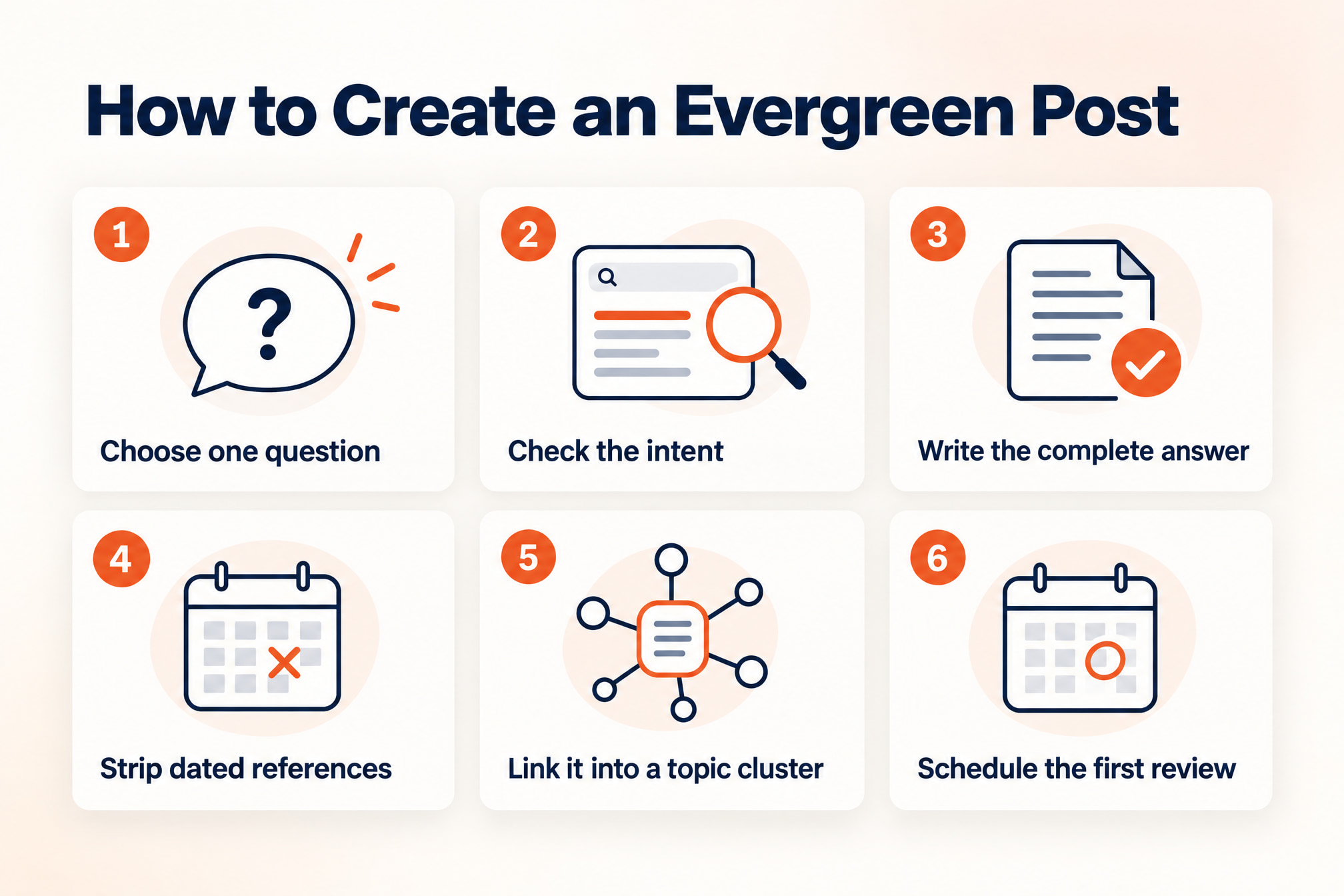
- Choose one question. Pick a single problem from your topic list. One post, one question, one search intent.
- Check the intent. Search the keyword and read what ranks. Note the format, depth and follow-up questions. Then write it all into a brief, using what a content brief includes as your checklist.
- Write the complete answer. Answer the question in the first sentence. Cover the follow-ups so the reader doesn't need a second tab. Pair every statistic with its source.
- Strip dated references. Cut "this year," "recently," slang, pop culture and trend nods. Where a date matters, put it next to the fact. That shows readers the data's age and shows you what to update later.
- Link it into a topic cluster. A topic cluster is one broad pillar page plus several narrower posts that link to it and to each other. Add links both ways, so search engines and readers can see how the pieces fit.
- Schedule the first review. Put a dated review in the calendar before you publish. Then promote the post through a content distribution strategy, and plan to repromote it after each refresh.
Our tool, Serpjoy, covers the research and writing steps for every post. It studies what already ranks, reads 70 to 100 sources and pairs each statistic with its source. It also asks you two or three questions, because your experience is the part no source has.
Refresh With Substance Every 6 to 12 Months, Never Just the Date
Updating old posts increased their monthly organic search views by an average of 106%, according to HubSpot. It calls the practice historical optimization.
The shortcut doesn't count. Google's guidance on helpful content lists "changing the date of pages to make them seem fresh when the content has not substantially changed" as a warning sign. A new date on old advice fools nobody, including the ranking systems.
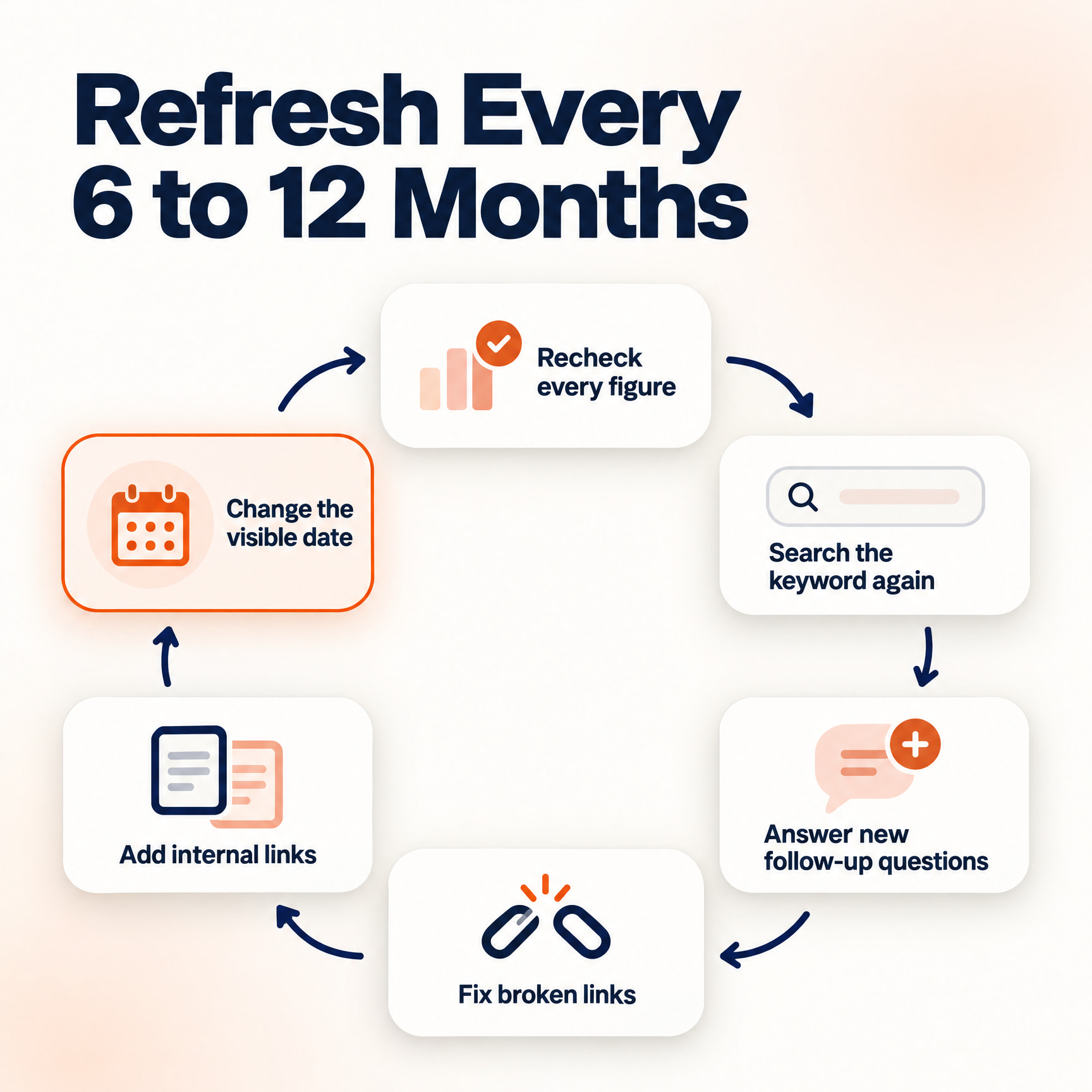
We'd review each evergreen post every 6 to 12 months, and sooner for topics tied to tools or rules that change. Run this audit each time.
- Recheck every figure and its source. Replace any figure that has newer data.
- Search the keyword again. See whether the intent or the format of the top results has shifted.
- Answer new follow-up questions that appear in People Also Ask or AI answers.
- Fix broken links, outdated screenshots and steps for tools that have changed.
- Add internal links from posts you've published since the last review.
- Change the visible date only after the content has changed.
Track each post's organic clicks, ranking position and conversions over twelve months. A steady decline is your trigger for an early review. So is losing a featured snippet or another of the SERP features worth winning that the page used to hold.
Quick Answers
What is considered evergreen content?
Evergreen content is any content that stays relevant and useful long after it's published. How-to guides, beginner guides, definitions and FAQs about persistent problems are typical examples. News and trend pieces are not.
What is another word for evergreen content?
Timeless content and perennial content mean the same thing. Merriam-Webster glosses "evergreen" itself as "perennial."
What are the 7 main types of evergreen content?
The seven formats that last longest are how-to guides, tutorials, FAQs, listicles, definitive guides, infographics and videos. Beginner guides are a close eighth.
Start With the Three Older Posts Already Carrying Your Traffic
Open your analytics today. Find the three posts that brought the most organic traffic last year and are more than a year old. Those are your evergreen pages, whether you planned them or not.
When you do write new ones, Serpjoy produces researched, cited posts in your voice, and the first costs $1 with no subscription. But put a dated, substantive review for those three posts in your calendar this week first. They're already doing the work.