


Content writing pricing runs from $15–$40 an hour for content writers on Upwork to 25–40¢ a word, the Editorial Freelancers Association's median range for ghostwritten blog posts. The two look like separate markets. Mostly, they pay for different numbers of hours.
In a Peak Freelance survey of 213 freelance writers, the most common price for a 1,500-word blog post was $250–$399. Once you know how long a post takes, any quote like that turns into an hourly rate. Then you can see whether it's fair, whether you're hiring or quoting.
Content Writing Pricing at a Glance in 2026
Content writing in 2026 falls into four price bands, and the gaps between them come from hours and expertise more than word count. Figures marked ≈ are our own conversions at Orbit Media's average writing pace, which is explained further down.
| Band | Per hour | Per word | 1,500-word post | Source |
|---|---|---|---|---|
| Marketplace writers | $15–$40 | ≈4–10¢ | ≈$57–$152 | Upwork |
| Working freelancers | ≈$66–$105 | ≈17–27¢ | $250–$399 | Peak Freelance |
| Professional ghostwriters | $75–$100 | 25–40¢ | ≈$375–$600 | EFA |
| Advanced writers | ≈$394–$590 | $1–$1.50 | ≈$1,500–$2,250 | Upwork |
Read the bands with two cautions. Upwork draws on writers worldwide, so its rates run lower than US association rates and aren't a like-for-like comparison. And every survey figure shows what writers reported charging. None of them is a recommended price.
The EFA figures cover content published without the writer's byline. If your posts go out under a founder's name, you're buying ghostwriting, and the EFA rates are the right benchmark.
Four Pricing Models, Each Putting the Risk on a Different Side
The pricing model a writer uses decides who pays when a post takes longer than planned. Writers usually price by the word, the hour, the project or the day. This table shows where the overrun lands under each one.
| Model | Who absorbs overruns | Works best for |
|---|---|---|
| Per word | Writer | Steady blog volume |
| Per hour | Client | Work nobody can scope yet |
| Per project | Writer, within scope | Clearly defined deliverables |
| Day rate | Client | Launches and short sprints |
| Retainer | Writer, up to agreed volume | Ongoing monthly output |
Per Word
Per-word pricing gives the buyer a fixed price and leaves the writer to absorb any extra research. A thin topic and a thorny one cost the same per word. Experienced writers handle that by quoting a higher rate for hard subjects so they aren't working hours for free. The EFA lists both per-word and hourly medians for this reason. Each one is a check on the other.
Per Hour
Hourly pricing is the fairest model for work with an unclear scope, but the buyer carries the risk. It's the norm on marketplaces. Upwork puts SEO content writers at a $23 median and blog writers at $22, both in a $15–$35 range. If you pay by the hour, agree on a cap before work starts.
Per Project
A flat fee per post is how many freelancers quote blog work, and it holds up only when the scope is tight. The price should name the word count, the number of revision rounds and what research is included. Without those, the first disagreement turns a flat fee into a negotiation.
Day Rates and Retainers
UK copywriters have mostly moved to day rates. The ProCopywriters Survey 2026 of 573 commercial writers puts the median freelance day rate at £440, up 10% in two years. Most of its 383 freelance respondents charge between £300 and £1,800 a day. A retainer is a fixed monthly fee for a set volume of work. It trades a small discount for guaranteed income on the writer's side.
The Conversion That Makes Any Quote Readable
Every per-word or per-project quote hides an hourly rate, and Orbit Media's survey data lets you find it. In Orbit Media's 2026 survey of 1,042 content marketers, the average blog post took 3 hours 20 minutes to write. That's down from a peak of 4 hours 10 minutes in 2022. The same Orbit Media survey puts the average post at 1,312 words.
That works out to about 394 words an hour. Multiply a per-word rate by 394 to get the hourly rate. Divide an hourly rate by 394 to get the per-word rate. At that pace, 10¢ a word is about $39 an hour and 30¢ is about $118. Upwork's $25 median comes to roughly 6¢ a word.
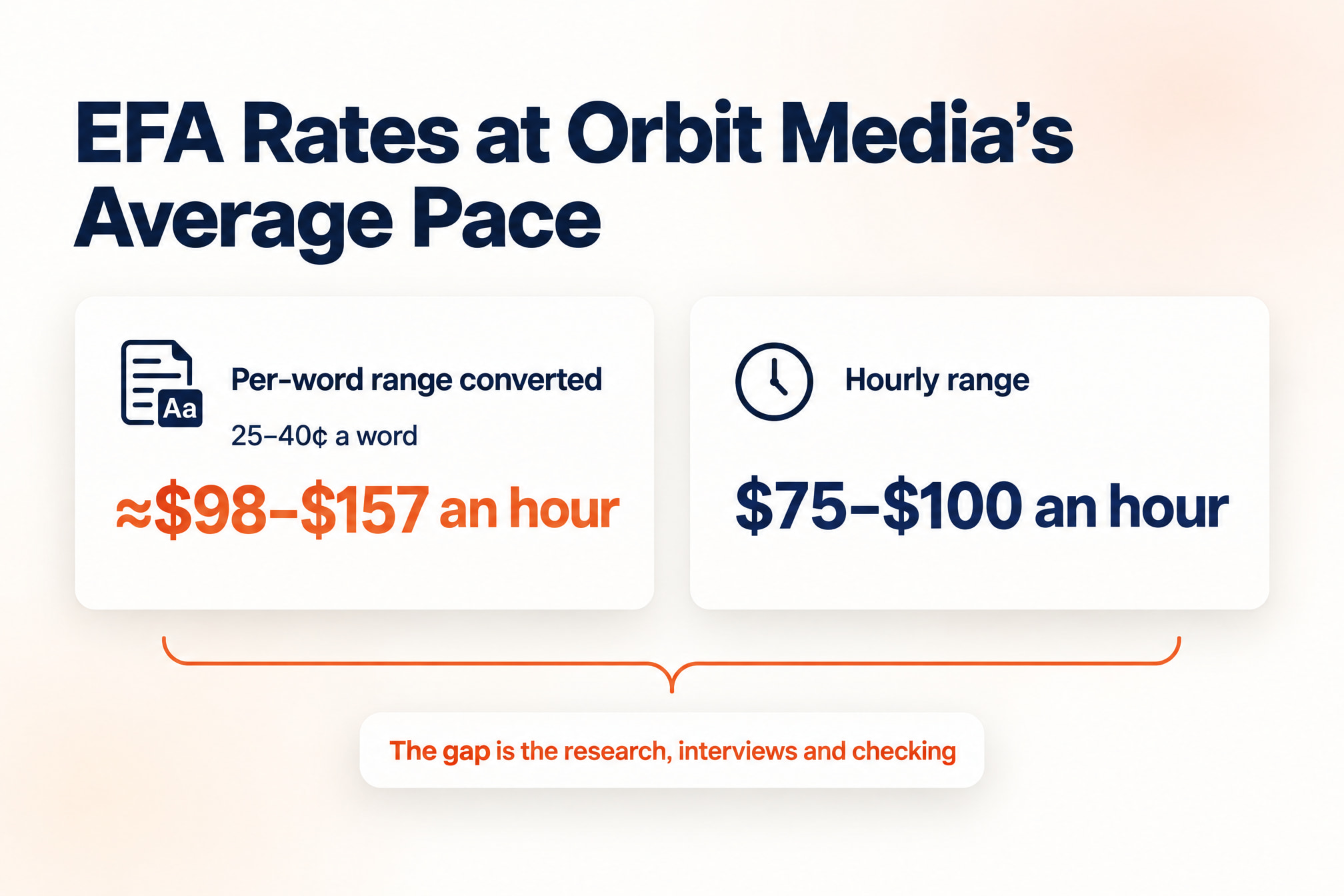
The EFA's figures show where the average breaks down. Its 25–40¢ per-word range converts to about $98–$157 an hour at Orbit's pace, which is above its own $75–$100 hourly range. The two ranges agree only if a professional spends roughly four to five hours on a 1,312-word post. That extra time is the research, interviews and checking you pay a professional for.
That's why expertise, research depth, topic complexity and turnaround all change the price. Each one either adds hours or makes an hour harder to replace. A rush job also pushes other clients' work aside, so expect a premium for it.
What a 500, 1,000 or 1,500-Word Blog Post Costs
A 1,500-word blog post most often costs $250–$399 from a freelance writer, and shorter posts scale down from that. The table prices three common lengths at Orbit Media's average pace. The marketplace column uses Upwork's $25 median. The middle column scales Peak Freelance's most common band. The professional column applies the EFA's 25–40¢ range.
| Length | Hours at average pace | Marketplace | Working freelancer | Professional |
|---|---|---|---|---|
| 500 words | ≈1.3 | ≈$32 | ≈$83–$133 | $125–$200 |
| 1,000 words | ≈2.5 | ≈$64 | ≈$167–$266 | $250–$400 |
| 1,500 words | ≈3.8 | ≈$95 | $250–$399 | $375–$600 |
Short posts rarely scale down neatly. Reading the brief, checking sources and sending the draft take about the same time whatever the length. Many writers set a minimum fee per post for that reason, and it's a fair one.
Experience Raises Rates Only When It Cuts Hours or Adds Expertise
Experience pays when it makes a writer faster or brings knowledge a client can't easily find. Upwork's freelance writing rates guide lists $0.30–$0.50 a word for intermediate writers and $1–$1.50 for advanced ones. Yet its median content writer charges $25 an hour. At average pace, 30¢ a word is about $118 an hour, close to five times that median.
The gap tells you something. Most marketplace writers sit near the bottom of the range, and a minority with proven results charge the guide's rates. A beginner should expect the low end of Upwork's $15–$40 range until they have published samples that rank.
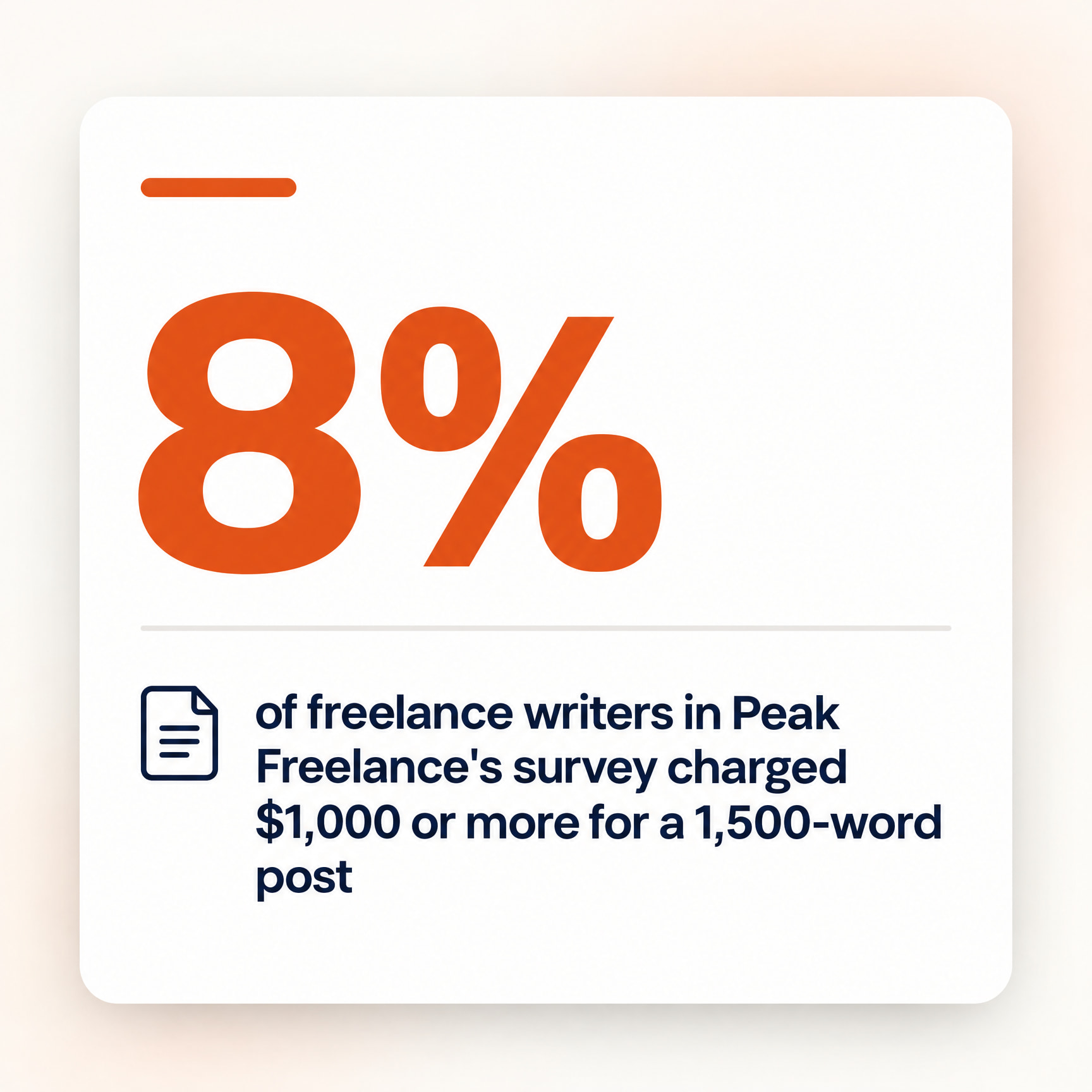
You can get paid $1 a word, but few writers do. In Peak Freelance's survey, only 8% charged $1,000 or more for a 1,500-word post, which is still under 67¢ a word. At average pace, $1 a word is about $394 an hour. Clients pay that for original data, expert interviews or subject knowledge they can't buy anywhere else.
Content Type and Niche Change the Hours, So They Change the Price
Content type and niche move prices because they change how much research and expertise a piece needs. Word count matters less than you'd think.
Each Content Type Carries a Different Research Load
Even within ghostwriting, the type of piece shifts the per-word rate. The EFA puts the median for ghostwritten articles and essays at 15–30¢ a word, below the 25–40¢ for blog posts. Its hourly range is $75–$100 for both. The hourly rate holds steady while the words per hour change.
For formats without reliable public benchmarks, estimate the hours, then apply the writer's hourly rate. This table shows what drives the hours for each common type.
| Content type | What takes the time | Model that fits |
|---|---|---|
| Blog post | Source research and SEO | Per word or per post |
| Website copy | Messaging rounds with stakeholders | Per page |
| White paper | Interviews and original research | Per project |
| Case study | Customer interview and approvals | Per project |
| Testing variants and sequencing | Per email or sequence | |
| Social posts | Volume and platform-by-platform rewrites | Retainer |
Specialist Niches Command a Premium
Technical and medical writing pay more than general content because fewer writers can do them accurately. The salary gap shows it. The Bureau of Labor Statistics put technical writers' median pay at $90,390 in May 2025. That compares with $76,910 for writers and authors overall. Expect freelance quotes in technical niches to carry a similar premium over general blog rates.
A Fair Quote Spells Out Research, Revisions and SEO
A cheap quote that leaves out half the work often costs more once you pay for the missing half yourself. Before comparing prices, check that each quote covers the same things.
- Research depth, including how many sources and whether claims are cited
- Interviews with you, your team or customers
- An outline you approve before drafting starts
- The number of revision rounds, stated as a number
- SEO work, such as keyword targeting, headings and a meta description
- Editing and fact-checking before delivery
- Images, or a clear note that you supply them
- Byline, rights and turnaround time
Your side of the deal matters too. A clear content brief cuts both research time and revision rounds, and those are two of the biggest drivers of the hours you pay for.
Freelancer, Agency or In-House Writer: What Each Really Costs
An in-house writer looks cheapest per hour until you add everything a salary leaves out. This table sets the main options side by side.
| Option | Typical cost | What you also pay for |
|---|---|---|
| Marketplace freelancer | $15–$40 an hour (Upwork) | Your time briefing and editing |
| Professional freelancer | $75–$100 an hour (EFA) | Little, if the quote is complete |
| UK freelance copywriter | £440 a day median (ProCopywriters) | Scoping the days needed |
| Agency | Writer's time plus margin | Account management layers |
| In-house writer | $36.98 an hour median pay (BLS) | Benefits, tools and quiet weeks |
Freelancers
Freelancers give you the widest price range and the most control over who writes. The spread between Upwork's median and the EFA's range is large. The cheaper end usually means more of your own time spent briefing and fixing drafts. Deciding when outsourcing content makes sense starts with counting those hours.
Agencies
Agency quotes bundle a writer's time with editing, project management and the agency's margin. Convert the quote to an implied hourly rate the same way, then ask how many of those hours the writer spends on your post. If most of the fee goes to coordination, you're paying for process rather than writing.
In-House Writers
The Bureau of Labor Statistics put median pay for writers and authors at $36.98 an hour in May 2025. That's before benefits and payroll costs, and you pay it in slow weeks too. Freelancers have to cover their own taxes, benefits and unbilled time, which is why their hourly rates run higher than a salary would suggest.
AI Writers
Full disclosure: we make Serpjoy, an AI blog writer. For each post it reads 70 to 100 sources on the live web, pairs each statistic with its source, and asks you two or three questions where your experience matters. Judge it by the same test as any quote, which is how many of your own hours the draft still needs.
Writers Need a Rate That Survives Fees, Taxes and Unbilled Hours
A $25 hourly rate on Upwork doesn't put $25 in your pocket. Freelancers pay Upwork a variable fee of 0–15% on all earnings, bonuses included. On a contract with a 10% fee, a $500 bill pays out $450. The variable fee took effect on May 1, 2025, replacing the old tiered 20/10/5% structure.
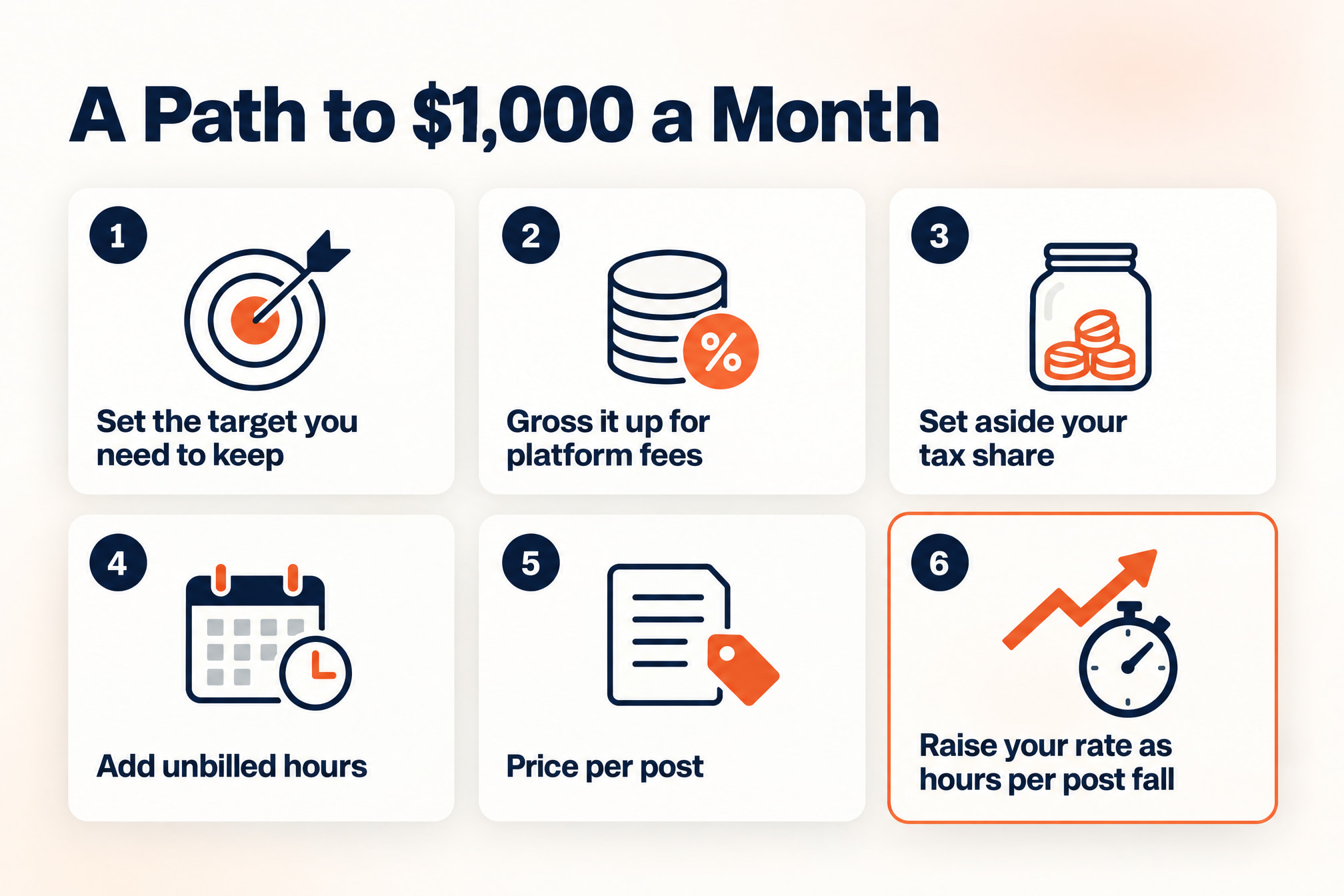
Here's a path to $1,000 a month in take-home income before tax, using a 10% fee.
- Step 1: Set the target you need to keep, in this case $1,000.
- Step 2: Gross it up for platform fees. At 10%, you need to bill about $1,111.
- Step 3: Set aside your tax share before you count anything as income.
- Step 4: Add unbilled hours for pitching, invoicing and unpriced revisions to your monthly time budget.
- Step 5: Price per post. At Peak Freelance's common $250–$399 band, $1,111 means three to five 1,500-word posts.
- Step 6: Raise your rate as your hours per post fall, so the speed gain becomes income.
So yes, $1,000 a month is realistic. Four 1,500-word posts at $250 bill $1,000, or about 15 hours of writing at Orbit Media's average pace.
Cheap Content Costs More Than It Saves
A post that never ranks earns nothing, whatever it cost. Low prices usually buy speed, and a rushed post rarely gets researched. The commodity end of the market is also shrinking. A study published in Management Science in 2025 found that within eight months of ChatGPT's launch, posts for automation-prone writing and coding jobs on a large freelancing platform fell 21% compared with manual-intensive jobs. The jobs that remained were more complex and paid more.
For buyers, a quote that converts to well under $15 an hour means the writer is very fast or is skipping the research. For writers, competing at that level means competing with software. Judge spending by what content returns rather than by the invoice alone.
Quick Answers
How Much Should I Charge for a 500-Word Article?
Charge about $83–$133 if you work in Peak Freelance's most common band, or $125–$200 at the EFA's professional ghostwriting rates. Set a minimum fee, since short posts still need briefing and research.
How Much Should I Charge for a 1,000-Word Article?
About $167–$266 in the common freelance band, and $250–$400 at EFA professional rates. At Upwork's $25 median hourly rate, it comes to roughly $64.
Can I Make $1,000 a Month Freelance Writing?
Yes. Four 1,500-word posts at $250 each bill $1,000. On a platform with a 10% fee, you'd need to bill about $1,111 to keep $1,000 before tax.
Can I Get Paid $1 per Word to Write Articles?
Yes. Upwork lists $1–$1.50 a word for advanced writers, but it's rare. Only 8% of writers in Peak Freelance's survey charged $1,000 or more for a 1,500-word post.
Run Your Last Quote Through This Check
Three lines of arithmetic tell you whether any content writing quote is fair.
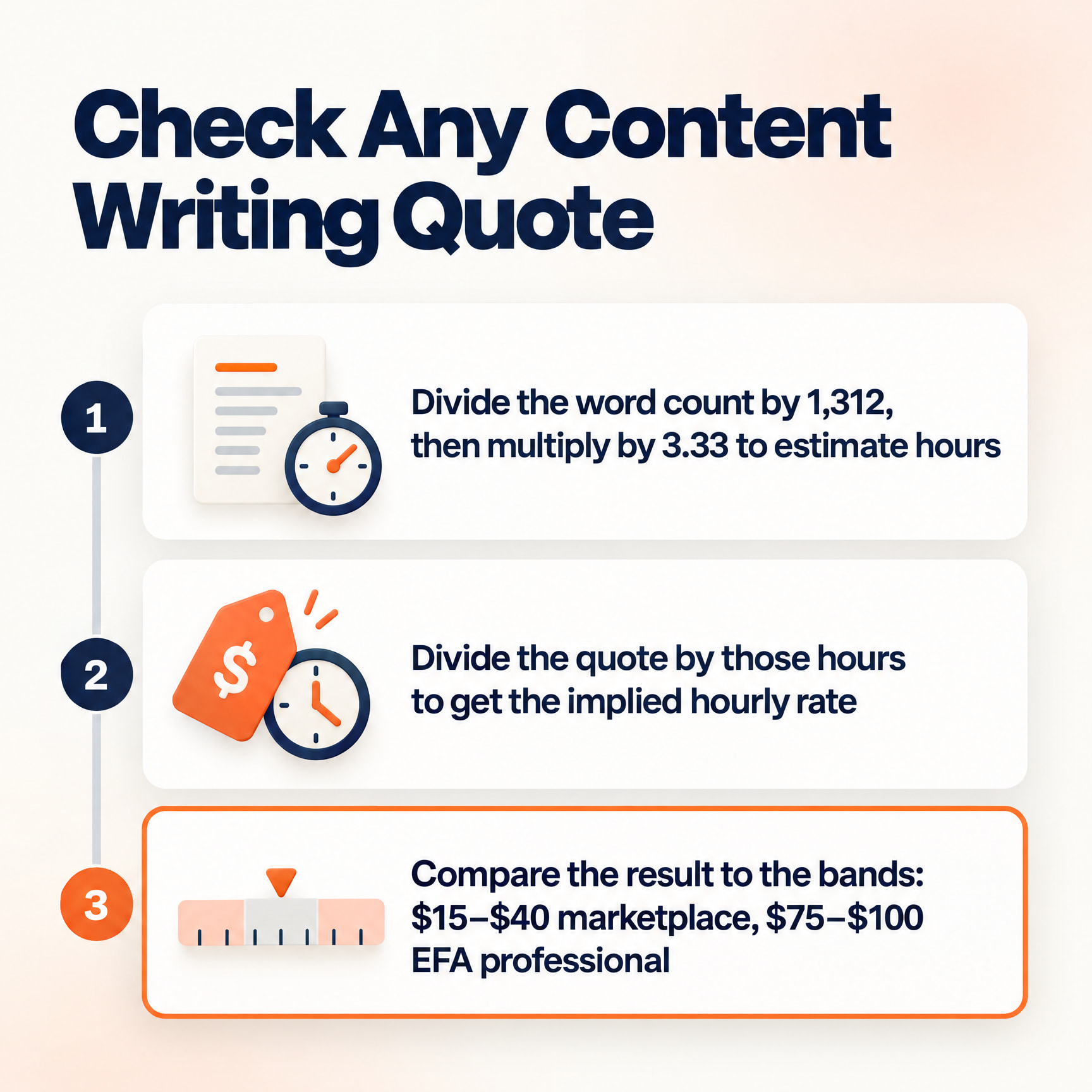
- Divide the word count by 1,312, then multiply by 3.33. That gives the estimated hours.
- Divide the quote by those hours. That gives the implied hourly rate.
- Compare the result to the bands. Under $15 is below Upwork's typical range, $15–$40 is marketplace, and $75–$100 is EFA professional. Anything far above that should come with expertise you can name.
For example, a $600 quote for 2,000 words works out to about 5 hours and $118 an hour. That's professional pricing, so the quote should include professional research. Run the last quote you received, or sent, through it today.
If you want a benchmark draft to compare against, Serpjoy writes researched, cited posts in your voice, and your first post costs $1. You can read example posts before you order.