


Ghostwriting is the practice of a hired writer producing books, speeches, articles or posts that are published under someone else's name. The Editorial Freelancers Association describes ghostwriting as work-for-hire writing done in the other person's voice and attributed to that person's authorship. Celebrities, executives, politicians and busy professionals hire ghostwriters, who interview them, draft in their voice and revise until the client signs off. Credit ranges from none to a "with" or "as told to" line, and the practice is accepted in publishing but treated as misconduct in academic and medical papers.
Most people asking what ghostwriting is want the answer to a second question: is it cheating? Mostly no, because the ideas belong to the named author and the ghostwriter supplies the sentences. The cases that do cross the line, student essays and medical papers, come with hard numbers and, in England, a criminal law.
What Is Ghostwriting? A Definition You Can Quote
Ghostwriting is writing done by one person and published under another person's name, and Merriam-Webster defines a ghostwriter as "one who writes for and in the name of another."
The phrase doing the work there is "in the name of." The work is credited to the client, whose name goes on the cover or the byline. The ghostwriter is typically paid instead of credited.
The label is younger than the job. Merriam-Webster dates the first known use of the verb "ghostwrite" to 1927, as a back-formation from "ghostwriter." That date covers the word only, so don't read it as the year people started writing for each other.
A simple test sorts real ghostwriting from fraud. Did the named author supply the ideas, approve the text and agree to the arrangement? If yes, it's ghostwriting. If not, it's something else with a worse name.
Definitions are tidy. The daily work is messier, and it comes down to one skill.
What a Ghostwriter Does All Day
A ghostwriter interviews the client, captures their voice, drafts the content and revises it until the client is happy to publish it under their own name.
Writing well is the easy part. Writing well as somebody else is the job.
So a good ghostwriter listens for small habits. Which words the client repeats. Whether they tell the story before the point or after it.
Many ghostwriters work as freelancers, so one week can mean a memoir chapter for one client and a batch of LinkedIn posts for another. The voice switches. The standards don't.
If you're hiring, ask for samples written in other people's voices. A writer's own polished essays show you their personal style, which is the one thing you aren't buying.
That voice-matching skill shows up across very different formats.
Types of Ghostwriting: Books, Memoirs, Speeches and Blogs
Ghostwriting covers books, memoirs, autobiographies, speeches, op-eds, blog posts and LinkedIn content, so the celebrity book on the airport shelf is only one corner of the work.
The main types of ghostwriting, and what changes between them, are:
- Books, memoirs and autobiographies: the longest projects, built on hours of interviews and a long stretch of drafting.
- Speeches: written for the ear, with short lines and room to pause. A political speechwriter is a ghostwriter for the spoken word.
- Op-eds and articles: one sharp argument under an executive's or expert's byline.
- Blog posts and newsletters: regular, shorter pieces that keep a founder or company publishing.
- LinkedIn content: short posts in a personal voice, which makes voice matching harder, not easier.
- Fiction and song lyrics: the same arrangement, with the writer's work released under someone else's name.
The short formats get underrated. A short LinkedIn post has nowhere to hide a sentence the client would never say.
If you want a feel for blog content written to match a brand, look at these example blog posts in a brand's own voice.
The format depends on who's paying. And the reasons people pay vary more than you'd guess.
Who Hires Ghostwriters, and Why They Bother
Celebrities, executives, politicians and busy professionals are the most common clients for ghostwriters, and they hire for time, writing skill or credibility.
Time is the big one. A CEO can have a book's worth of material in their head and no spare evenings to type it. Celebrities have a story people want and a schedule that won't allow a manuscript.
Skill comes next. Plenty of sharp people talk well and write badly. Talking and writing use different muscles.
Then credibility. Founders and consultants use op-eds, blogs and LinkedIn posts for thought leadership. Politicians need speeches on a schedule no single person could keep up with.
One reason doesn't work: having nothing to say. A ghostwriter shapes your ideas. They can't supply them, and if they do, the name on the cover is lying.
Assuming you do have something to say, here's how it gets from your head to the page.
How the Ghostwriting Process Works, Step by Step
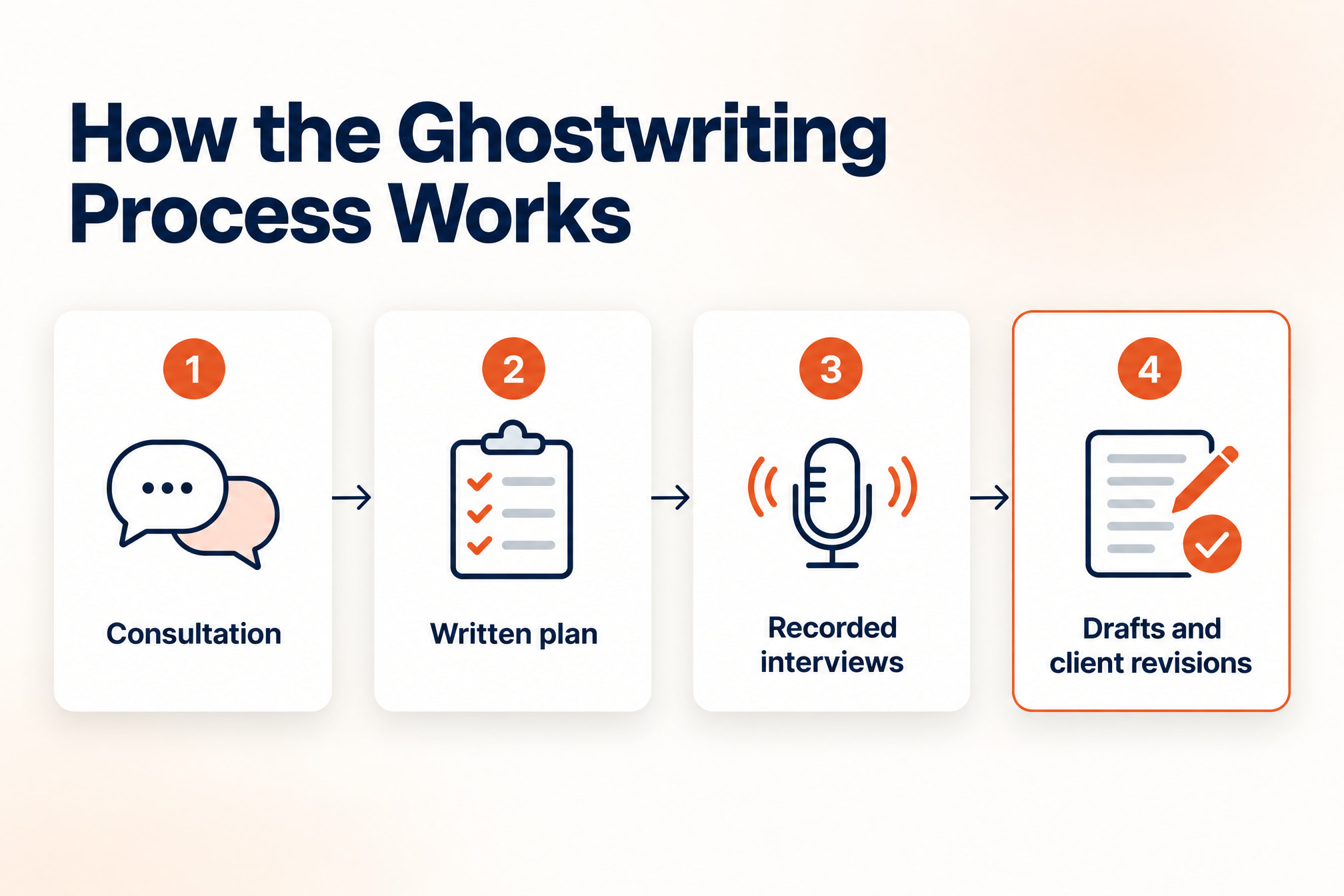
The ghostwriting process runs through a consultation, a written plan, recorded interviews, and rounds of drafts and client revisions before anything is published.
Consultation and the Book Plan
A ghostwriting project starts with a consultation and a written plan that fixes the scope, audience, length and deadline.
For a book, that plan is an outline with chapter notes. For a blog series, it looks a lot like a content brief that sets scope, voice and deliverables.
Before the first call, write down who the piece is for, what they should believe afterward, and a few stories only you can tell. It's a short job. It saves a lot of drift later.
Interviews and Voice Capture
Interviews are where a ghostwriter captures the client's voice, stories and opinions, usually through recorded conversations that become raw material for the draft.
The best raw material is you, talking, unedited. Rambling is fine. Tangents are often where the good lines hide.
Hand over anything else that sounds like you: old talks, long emails, voice notes. The more of your real voice the writer hears, the less they guess at your writing style.
Drafts and Revisions
Drafts and revisions turn interview material into finished text, and the named author reviews and approves each draft before publication.
Read every draft out loud. If you'd never say a sentence in a meeting, mark it.
Vague notes like "make it punchier" waste a round. Point at the exact line instead.
Once the text is yours in every way that counts, one question is left. Whose name goes where?
Do Ghostwriters Get Credit? Bylines, Anonymity and NDAs
Ghostwriting credit ranges from complete anonymity to a "with" or "as told to" credit on the cover, and the contract between writer and client decides which applies.
Anonymity is common for speeches, op-eds and social posts. Nobody expects a CEO's LinkedIn post to carry a second byline. Books are where the credit line gets argued over.
Credit matters to the writer more than clients assume. Fees tend to rise with a writer's experience and credentials, and work nobody can see is hard to put in a portfolio.
Confidentiality is the other half. A nondisclosure agreement or confidentiality clause controls what the ghostwriter can say about the project, during the work and after it.
Settle these points in writing before the first interview:
- The credit line: none, "with," or "as told to."
- Whether the writer can name the project to future clients.
- What the nondisclosure agreement covers, and for how long.
- Who owns the interview recordings and transcripts.
- What happens to payment and drafts if the project stops halfway.
Skip this and the fight comes later, usually when the book does well. Which brings us to money.
How Much Does Ghostwriting Cost?
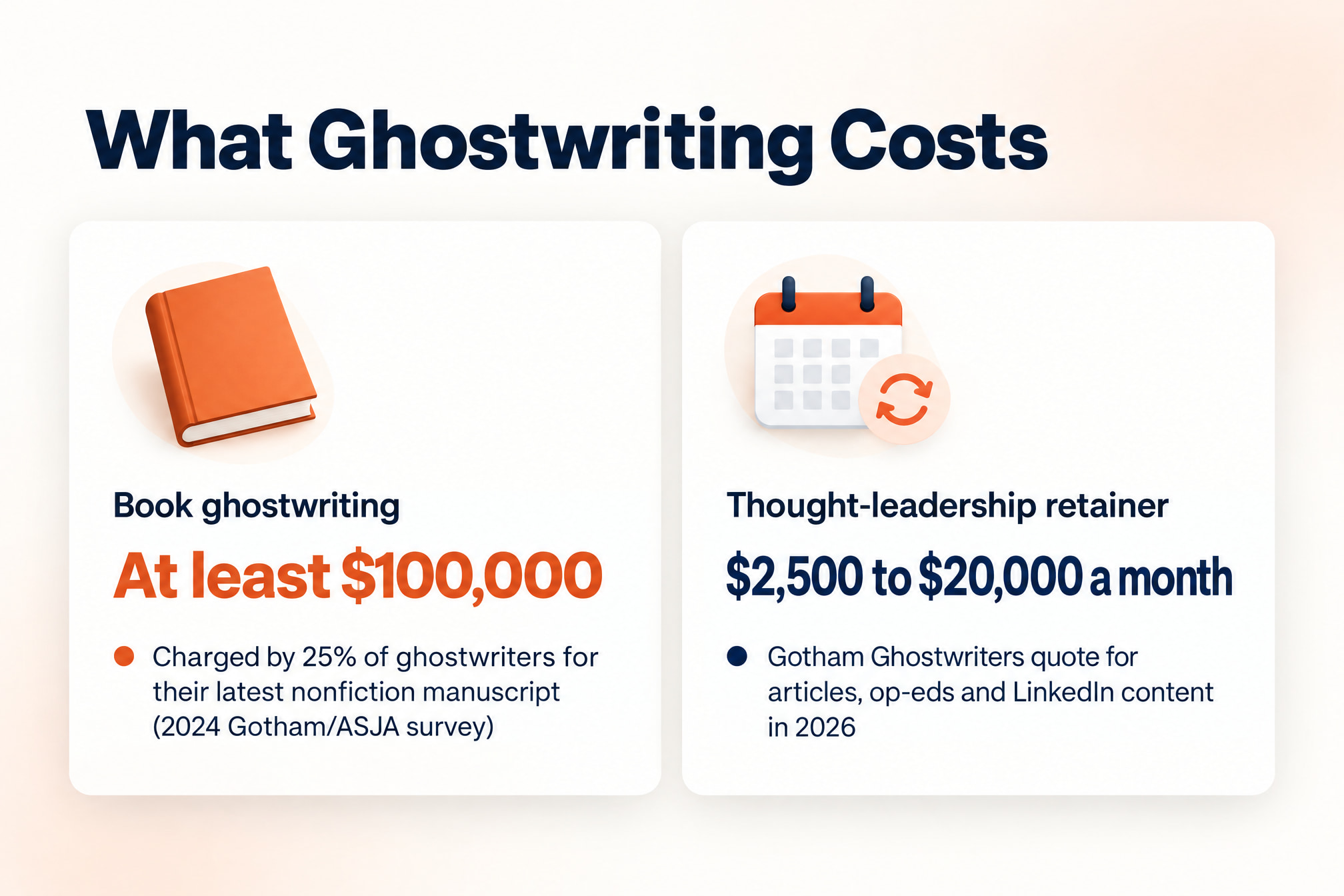
Ghostwriting costs anywhere from a monthly retainer to six figures per book, and 25% of ghostwriters in a 2024 Gotham/ASJA survey charged at least $100,000 for their latest nonfiction manuscript.
Read that as the top end of the market. Below it, prices swing widely with the writer's track record.
What Book Ghostwriters Earn
Book ghostwriting pays well at the top, and one-third of 269 book ghostwriters in the 2024 Gotham/ASJA survey earned over $100,000 a year from ghostwriting books.
That's a full professional income for a large minority of the trade. It also explains the price tag. You're paying for a big slice of someone's working year.
Retainers for Articles and LinkedIn Posts
Ongoing thought-leadership ghostwriting can be priced as a monthly retainer, and Gotham Ghostwriters quotes $2,500 to $20,000 a month for articles, op-eds and LinkedIn content in 2026.
That's one agency's range, so use it as a reference point. The spread is wide because "a LinkedIn post now and then" and "a full op-ed program for a CEO" are different jobs.
Questions to Ask About Payment Models
Ghostwriting payment models differ by writer and project, so ask each candidate how their quote is structured before you compare prices.
Ask whether it's a flat project fee or tied to word count. Ask how payments split across milestones.
For a book, ask whether any share of royalties or the advance is part of the deal. Two quotes that look alike can mean very different things once you see the schedule.
Price and credit both make more sense with a real case in front of you. One recent memoir put a ghostwriter's name in the headlines.
Spare: The Ghostwritten Memoir That Set a Sales Record
Prince Harry's memoir Spare, released on January 10, 2023, was ghostwritten by J.R. Moehringer, a Pulitzer Prize-winning journalist and novelist.

The ghostwriter's name was in the news on release day. Readers bought it anyway. Penguin Random House reported first-day sales of more than 1.43 million copies of the English-language edition across all formats in the US, Canada and the UK.
Known help didn't dent demand. The story was Harry's, and that's what people paid for.
Penguin Random House called it the largest first-day total for any nonfiction book it had published. That's a record for one publisher, not the whole industry. It's still a striking result for a book whose ghost made the news.
Then Moehringer did something ghostwriters rarely do. He described the collaboration in a May 2023 essay for The New Yorker.
Most ghostwriters never get that chance. Anonymity is part of the deal for many of them, sometimes written into a nondisclosure agreement. Good ghostwriting is built to stay invisible, which is why famous examples feel rare.
A celebrity memoir or autobiography with a hired writer sits fine with most readers. Other settings are far less forgiving.
Is Ghostwriting Cheating? Where the Ethics Line Sits
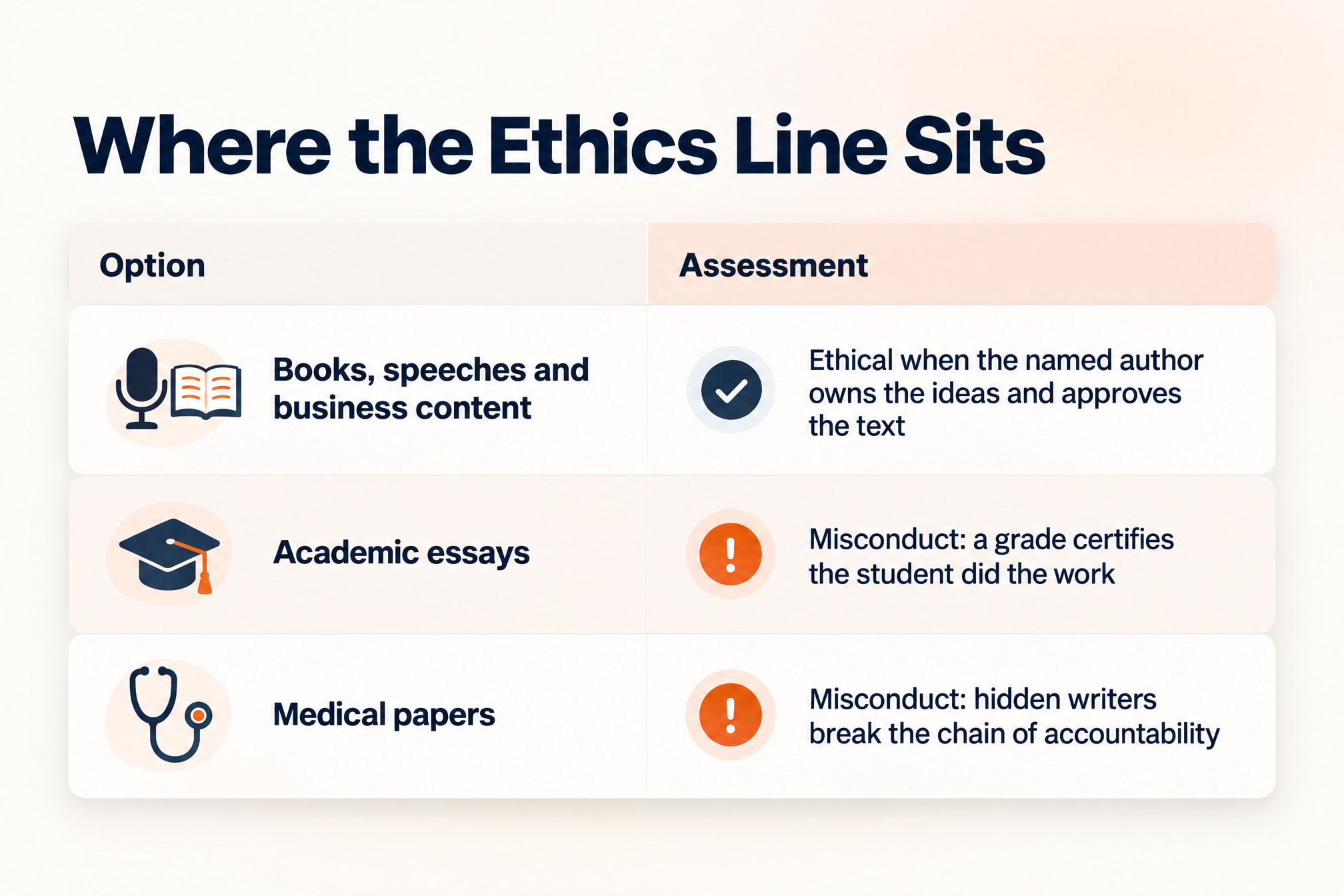
Ghostwriting is ethical when the named author owns the ideas and approves the text, but it becomes misconduct where authorship implies accountability, as in academia and medicine.
Books, Speeches and Business Content
Ghostwriting books, speeches and business content is ethical when the named author owns the ideas, approves every word and agrees to the arrangement.
Nobody judges a speech by who typed it. They judge whether the speaker means it. If a founder's blog post states her views and she signed off, the byline is honest.
Academic Ghostwriting and Essay Mills
Academic ghostwriting is misconduct because a grade certifies that the student did the work.
Under the Skills and Post-16 Education Act 2022, it's a criminal offence in England to provide, arrange or advertise contract cheating services to students for financial gain. The offence targets the essay mills and their advertisers, not the students who buy.
Either way, a bought essay is cheating in a way a ghostwritten memoir is not. One hides the author. The other hides the typist.
Medical Ghostwriting and Ghost Authorship
Medical ghostwriting is a problem because the named authors of a study vouch for its findings, and hidden writers break that chain of accountability.
A survey of authors in six leading medical journals found 21.0% of articles published in 2008 had honorary authorship, ghost authorship, or both. That was down from 29.2% in 1996. Better, but still a lot for journals doctors rely on.
Ghost authorship on its own showed up in about 8% of articles in high-impact medical journals in that 2008 data. In a field where one paper can shape treatment, that's no rounding error.
The overall scale depends on how you measure it. A 2019 review of ghostwriting in biomedicine found prevalence estimates from under 1% to 91%, depending on setting, method and definition. A range that wide mostly tells you nobody agrees on the definition.
If you publish in a field with authorship rules, read them before you hire anyone. In business and publishing, the test is simpler: your ideas, your approval, your name.
Quick Answers About Ghostwriting
The most common practical questions about ghostwriting concern getting started, how ghostwriters are paid, and whether ChatGPT can do the job.
How Do I Start Ghostwriting?
Starting as a ghostwriter means building writing samples in other people's voices and then finding clients, and many ghostwriters work freelance.
Practice on people you know. Interview a colleague, then write a short post they'd sign. If they say "that sounds like me," you have a sample.
Start with blog posts, newsletters and LinkedIn content before you pitch a book. The writing and SEO guides on the Serpjoy blog cover the blog side if that's your entry point.
Do Ghostwriters Get Paid?
Ghostwriters get paid a fee instead of author credit, and pay varies widely with experience and project type.
For broad context, the BLS puts the median annual wage for writers and authors at $76,910 for May 2025. That category isn't specific to ghostwriters, and it excludes the self-employed. Treat it as rough context, nothing more.
Can You Use ChatGPT as a Ghostwriter?
ChatGPT can draft text, but it only knows what you tell it, so it works as a ghostwriter's tool more than a full replacement for one.
Professional ghostwriters already use AI more than other writers do. The 2025 AI and the Writing Profession study found 68% of ghostwriters used AI, against 58% of nonfiction authors and 42% of fiction authors.
Use isn't trust, though. Only 11% of ghostwriters in the 2025 study called themselves advanced AI users, while 40% were "dabblers" and 31% didn't use it at all. The people paid to sound like someone else are wary of a tool that tends to sound like everyone.
So the work that matters is the input: your stories, your opinions, your way of putting things. That's why Serpjoy asks the author two or three questions where their experience matters before it writes a post.
Ghostwriting in Short: Your Ideas, Someone Else's Sentences
Ghostwriting is a paid, agreed arrangement in which a writer produces work credited to someone else, and it works best when the named author brings the ideas and approves every page.
If you're hiring, work in this order: your ideas, then the right writer, then the contract, then the interviews.
Today, write one page. Who it's for, what they should believe afterward, and the stories only you can tell. That's your brief.
Within a week, you should have that page, voice samples from two writers, and a draft contract covering credit, payment and the nondisclosure agreement. If a writer can't show you work in someone else's voice, keep looking.
The name on the cover should be yours because the thinking is yours. The sentences can come from someone you pay.