


Content outsourcing means paying a freelancer, agency or content partner to plan, write or produce some or all of your content. The alternative is doing it with your own staff. It's still common. But the way teams buy it is changing. In Forrester's 2026 survey, 26% of B2B brand and communications marketers expected to raise agency spending on content creation and development. A year earlier it was 41%. Deloitte found 70% of executives have pulled some outsourced work back in-house over the past five years.
Forrester links that drop to AI, which lets teams bring routine production in-house. Outsourcing still works. The teams doing it well keep the strategy, the voice and the final edit, and they buy the hours. That's the model we recommend for most small teams.
Content Outsourcing Comes in Four Forms, From Freelancers to Licensing
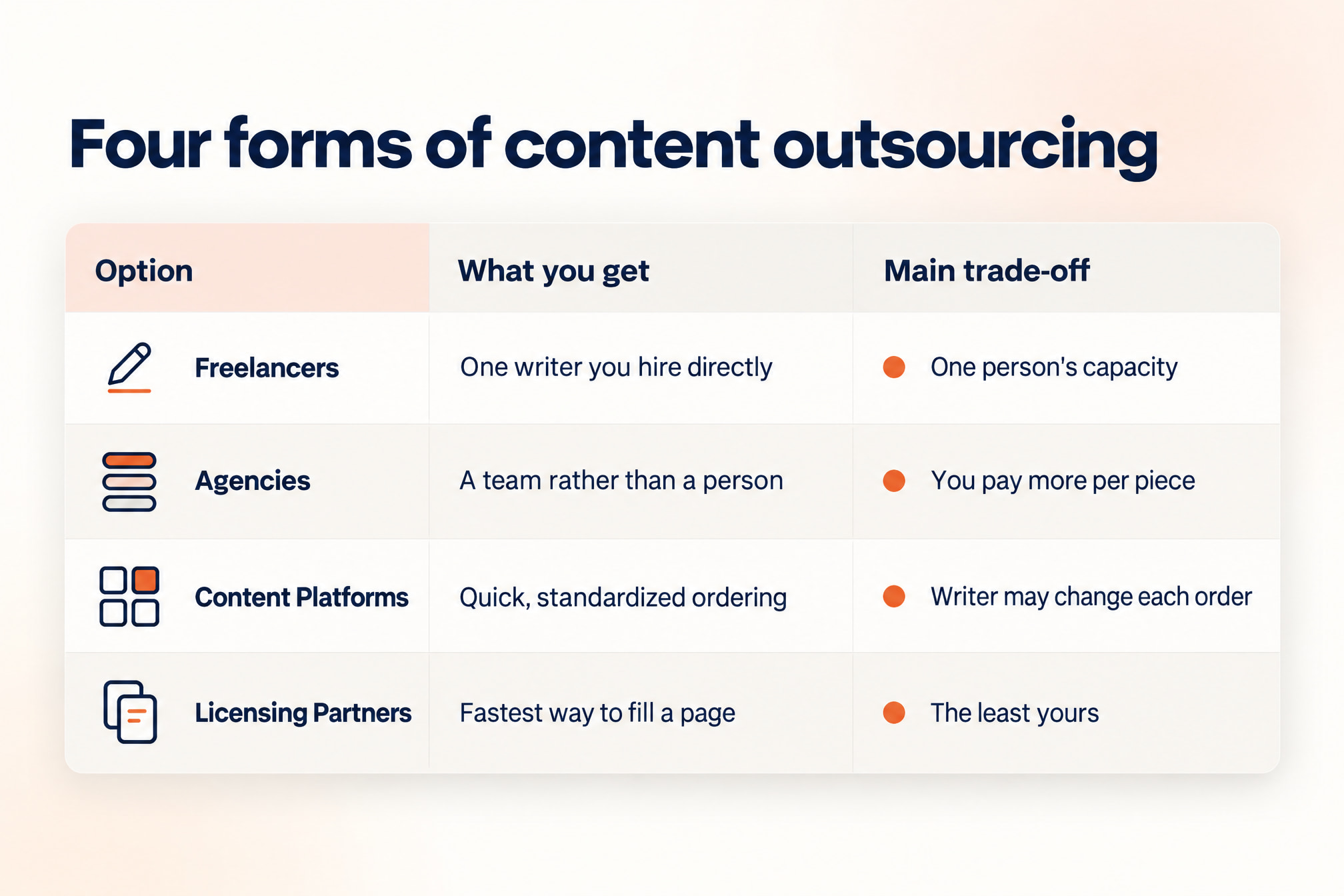
Most content outsourcing runs through freelancers, agencies, content platforms or licensing partners. They differ in price. They differ more in how much of your time each one needs.
Freelancers
A freelancer is one writer you hire directly, usually per piece or on a monthly retainer. You get a direct line to the person doing the work, so feedback is fast. You also get one person's capacity. A sick week or a better-paying client can stall your calendar. Much freelance blog work is ghostwriting, published under someone else's name, usually yours or your founder's.
Agencies
An agency gives you a team rather than a person. That usually means an account manager, several writers and an editor. You trade direct contact with the writer for cover and capacity. You pay more per piece for that layer of management. Agencies make sense when you need volume, several formats or someone to own the calendar.
Content Platforms
A content platform is a marketplace that matches your brief to a writer from its pool. Ordering is quick and the process is standardized. The trade-off is consistency. The writer may change from one order to the next unless you can request the same person each time.
Licensing Partners
A licensing partner lets you republish content that already exists, such as articles, reports or images, for a fee. It's the fastest way to fill a page. It's also the least yours. The piece wasn't written for your readers or in your voice, and other sites may run the same text. It fills gaps. It won't set your blog apart.
Blog Posts Outsource Easily, but Case Studies Need Heavy Briefing
Almost any content type can be outsourced, and the deciding factor is how much inside knowledge the piece needs. A how-to post can be built from good sources. A case study can't be written without your customer on the phone.
The table ranks common formats by how much briefing each one takes and what you have to hand over.
| Content type | Inside knowledge needed | Briefing effort | What you must supply |
|---|---|---|---|
| Blog posts and how-tos | Low to medium | Medium | A brief and your view |
| Infographics | Low | Low | The data |
| Video | Medium | Medium | Talking points |
| Landing pages | High | High | Your offer and its proof |
| White papers and reports | High | High | Data or an expert |
| Case studies | High | High | Customer access |
Start with the format that's easiest to brief and that you publish most. For most small teams that's blog posts. You publish them often, and a good brief closes most of the knowledge gap.
Outsourcing Buys Back Hours, Flexible Volume and Specialist Skills
You outsource content mainly to get your team's hours back. Flexible volume and specialist skills come next.
Companies still buy outside help across the board. Deloitte's outsourcing survey found 80% of executives plan to maintain or increase third-party outsourcing across business functions. Content sits lower on the list. In CMI and MarketingProfs research, 19% of B2B marketers put agencies or outsourcing among their top three areas for more investment in 2026. AI marketing tools came first, at 45%.
Your Team Gets Its Writing Hours Back
Orbit Media's 2026 survey of 1,042 content marketers puts the average post at 3 hours 20 minutes. That's down from 4 hours 10 minutes in 2022. It's still most of a morning per post, before anyone edits it.
Outsourcing moves the drafting hours to someone else. Your team spends its time on the brief and the edit, which is where its knowledge counts most.
Volume Goes Up or Down Without Hiring
Outsourced output scales with your plans, not your headcount. A launch month might need eight posts and a quiet quarter two. You pay for what you order. A salaried writer costs the same in both months, and hiring or letting someone go is slow and expensive.
You Rent Specialists You Couldn't Justify Hiring
Outsourcing gives a small team skills it needs a few times a quarter rather than every day. Technical SEO, design, video editing and expert writing in fields like finance or health rarely fit one generalist hire. A specialist freelancer or agency brings that skill only for the pieces that need it.
Fresh Eyes Catch What Insiders Stop Seeing
An outside writer asks the questions your customers ask. Teams that live inside a product skip steps and slip into internal shorthand. A writer who has to learn the product first tends to explain it more plainly. That only pays off if someone on your side answers their questions.
An In-House Writer Costs More Than the Salary Line Suggests
Unless you need a full-time writer's output, paying per project costs less. The Bureau of Labor Statistics puts median pay for US writers and authors at $76,910 a year, as of May 2025. That's pay alone. Benefits, payroll taxes, software, equipment and the time someone spends managing the role all come on top.
Here's how a salaried writer and pay-per-project compare on cost and control.
| Cost or factor | In-house writer | Pay per project |
|---|---|---|
| Base pay | $76,910 median | Per piece or retainer |
| Benefits and payroll taxes | You pay them | The freelancer's cost |
| Tools and software | Your expense | Usually theirs |
| Management time | Ongoing | Briefs and edits |
| Cost in a slow month | Full salary | Only what you order |
| Product knowledge | Deep and growing | Starts at zero |
| Control over priorities | Full | Set by contract |
Pay-per-project usually wins until your volume is steady enough to keep a writer busy all year. In-house wins on knowledge. That gap matters more for case studies and landing pages than for how-to posts.
What to Pay a Freelance Writer per Post
A fair rate pays for an experienced writer's time, so start from time. The BLS median works out to $36.98 an hour. Orbit Media's average post takes 3 hours 20 minutes. By our arithmetic, that's about $123 of writing time per post at median pay.
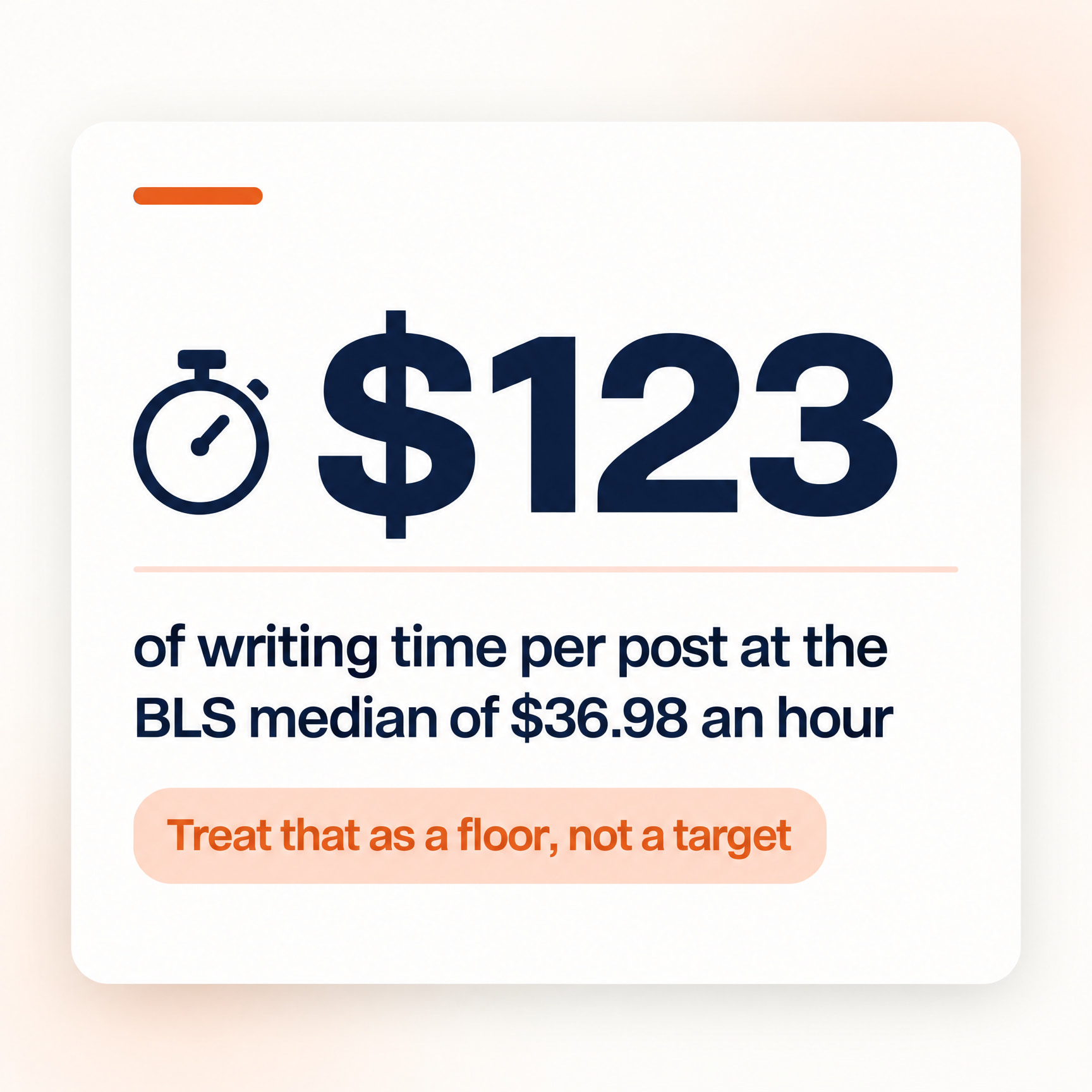
Treat that as a floor, not a target. It covers drafting only, at an employee's rate. A freelancer also pays their own taxes, tools and unbilled hours. Research, interviews and revisions take time on top. A quote well below the floor buys you less time on your post or less experience. Sometimes both.
Outsourced Content Fails on Voice, Product Depth and Paperwork
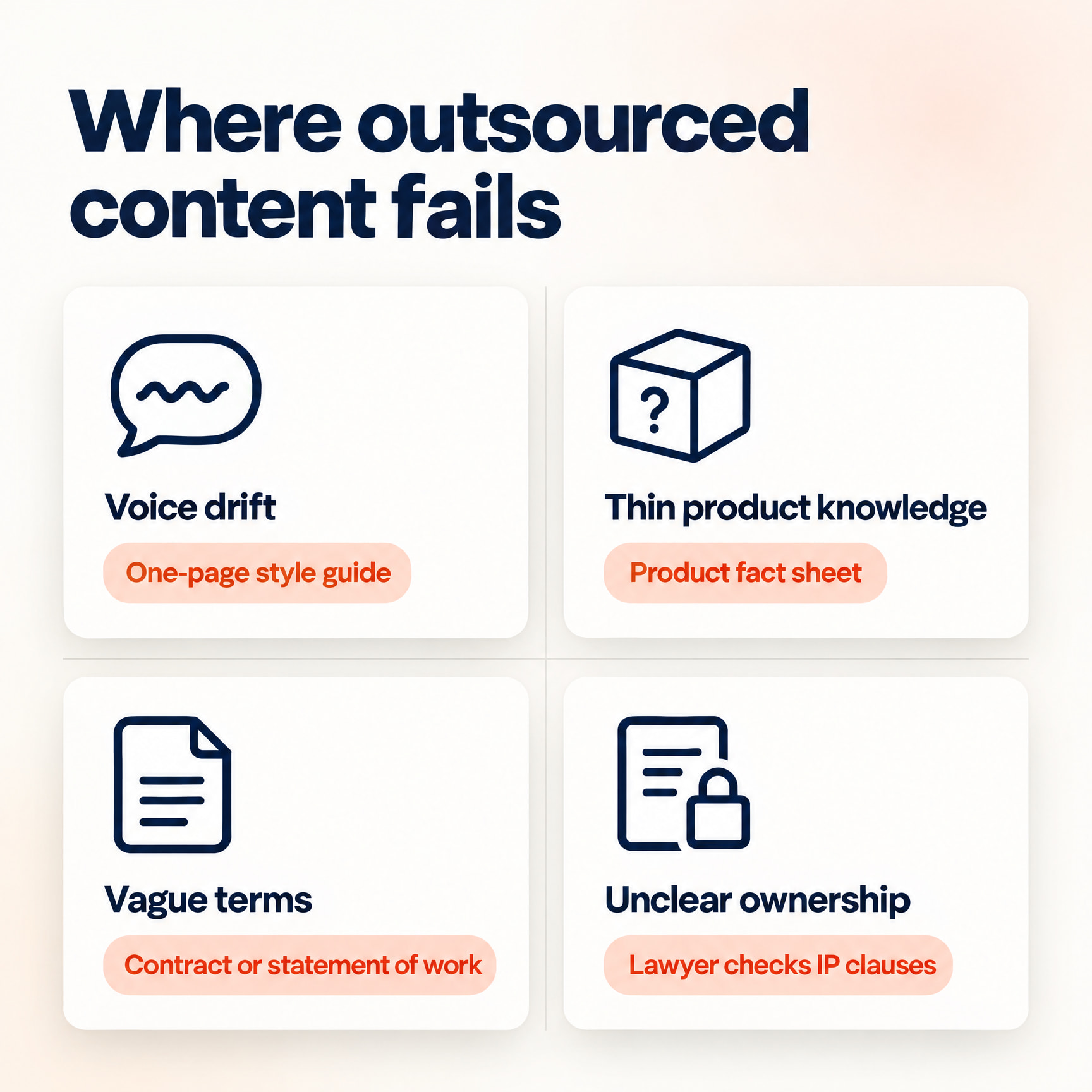
Outsourced content most often goes wrong in four places. The voice drifts, the writer doesn't know the product, the terms are vague, or ownership is unclear. Each one has a fix you can set up before the first piece.
Voice Drift Is the Most Visible Risk
An outside writer defaults to their own voice, or to a generic one, unless you show them yours. One post that sounds like a different company is a small problem. Twenty of them make your blog read like a content farm. The fix is a one-page style guide with example sentences, plus an editor on your side who reads every piece before it goes live.
Outside Writers Start With Thin Product Knowledge
Your team knows which features customers use, which claims legal won't allow and which competitor you never name. A freelancer knows none of that on day one. Thin knowledge shows up as vague claims and safe generalities. Send a short product fact sheet, hold a kickoff call and put your own notes in every brief. Then fact-check every claim and figure before publishing. The post carries your name, not theirs.
Revisions, Control and Confidentiality Belong in the Contract
Loss of control usually starts with a vague agreement. Vendors often cap revision rounds, set their own turnaround and may work for your competitors. That's normal. Write it down. Your contract or statement of work should name the deliverables, deadlines, revision rounds, payment terms and what the writer may not share. Add a clause on AI. Ask which tools the vendor uses, and for what, and agree on what they must disclose to you.
You Own the Work Only If the Paperwork Says So
Outsourcing content is legal in the US. Ownership is the part to get right. Under US copyright law, the hiring party owns a "work made for hire" in two cases. An employee created it as part of their regular job. Or it's a commissioned work in an eligible category, covered by an express written agreement. A freelancer isn't your employee, so only the second case can apply. Have a lawyer check the IP and ownership clauses before you sign.
Hybrid Is the Right Default for Most Small Teams
A hybrid model fits most small teams better than either extreme. Strategy, voice and the final edit stay in-house, and drafting or production goes outside. It matches where the data points. Forrester ties the fall in planned agency content spending to AI bringing routine production in-house. Deloitte's executives named building internal capability, better service quality and avoiding vendor mark-ups as reasons for taking work back.
The table shows when each model makes sense.
| Model | Strategy and voice | Drafting | Best fit | Main risk |
|---|---|---|---|---|
| Fully in-house | Your team | Your team | Steady high volume | Fixed cost when quiet |
| Fully outsourced | Vendor | Vendor | No marketing staff yet | Generic voice |
| Hybrid | Your team | Writers or tools | Small teams with a strategy | Editing bottleneck |
Keep the Judgement and Hand Out the Hours
The split is simple to state. Anything that decides what you say stays inside. Anything that turns that decision into finished pages can go out. Here's how common tasks divide.
| Keep in-house | Outsource |
|---|---|
| Content strategy and topics | First drafts |
| Style guide and voice | Source gathering |
| Product claims | Design and images |
| Final edit and fact-check | Video editing |
| Publishing sign-off | On-page SEO setup |
AI tools now fill part of the outsourced column. Full disclosure, we make Serpjoy, an AI blog writer. For each post it studies what already ranks, reads 70 to 100 sources, pairs each statistic with its source and asks you two or three questions where your experience matters. It slots into the drafting role. Your team still owns the strategy and the final edit.
Content Is Still Worth Making in 2026 If It Adds Something
Content still earns its cost in 2026 when each piece gives readers something the pages already ranking don't. Google says that using generative AI "to generate many pages without adding value for users may violate" its spam policy on scaled content abuse. A cheap post written only to fill a calendar has the same weakness with readers, whoever typed it.

You're ready to outsource when you have three things and lack a fourth. You have a content strategy, even a one-page one, that says who you write for and which topics matter. You have a backlog of topics you'd publish tomorrow if someone wrote them. And you have one person who can brief and edit. What you don't have is the hours to draft.
You're not ready if you'd be asking a vendor to decide what you stand for. An outsider can draft your opinions. They can't form them. If nobody on your team can edit, write two posts yourself and turn what you learn into a style guide. Then outsource.
Outsource Content in Eight Steps, Each With a Deliverable
A good outsourcing process leaves a document at every step, so nothing depends on memory or goodwill. Work through these in order.
- Audit what you publish. List what went out in the last six months, what ranks, what brings leads and what's missing. You end with a short list of content types and gaps.
- Set KPIs. Pick one or two outcomes per content type, such as ranking for a target keyword or sign-ups from a post. You end with targets you can check monthly.
- Set a budget. Start from the per-post floor above, multiply by your monthly volume and add your own editing time. You end with a monthly figure and a ceiling per piece.
- Define the scope. Decide which content types go out, how many pieces a month and who approves them. You end with a one-paragraph scope.
- Choose a partner. Shortlist two or three candidates, check their samples and run a paid pilot. You end with one vendor that passed a real test.
- Sign a contract or statement of work. Cover deliverables, deadlines, revision rounds, payment terms, confidentiality, AI use and ownership. Get the IP clause checked by a lawyer. You end with signed terms.
- Onboard with a style guide. Send the one-page guide below, a product fact sheet and three posts you'd hold up as the standard. You end with a writer who knows what good looks like.
- Brief every piece and give feedback. Each brief should name the goal, reader, keyword, search intent and outline, which is what a content brief includes when it's done properly. Return one round of combined feedback, not a trickle of comments. You end with a loop you can repeat.
Vet Writers on Relevant Samples, Then Pay for a Two-Piece Pilot
A paid pilot on your own topics tells you more about a writer than any portfolio. Referrals from founders and marketers you trust are the easiest place to find candidates. Freelance marketplaces, content platforms and agency directories widen the pool.
Before the pilot, check each candidate against this list.
- Samples in your field, or one close to it, at the depth you need.
- Sources linked inside the samples, next to the claims they support.
- A clear research process. Ask where facts come from and who checks them.
- A named editor, if it's an agency.
- A straight answer on AI use, including which tools and for what.
- Written agreement to your ownership terms.
- A revision policy you can live with.
Then commission two paid pieces from your backlog. Pick one easy topic and one that needs product knowledge. Time your own edit on each. A writer whose drafts need a full rewrite isn't saving you hours, whatever the rate.
A One-Page Style Guide Protects Your Voice Better Than Revisions
A style guide fixes voice problems before the first draft, which is cheaper than fixing them in the third round of edits. Copy this template, fill in the brackets and send it to every writer before their first piece.
- Who we write for. [Job title], who struggles with [problem] and already knows [what they know].
- What the reader does next. [Sign up, book a call or read a related post].
- Our voice in three words. [Word], [word], [word]. Add one sentence you'd publish and one you wouldn't.
- Words we use. [Your terms for your product, your customers and your category].
- Words we never use. [Banned phrases, competitor names, hype].
- Facts and sources. Every statistic links to its source and names who measured it. [Oldest data you'll accept].
- Product truths. [Three things the product does] and [one thing it doesn't].
- Format. [US spelling, heading case, typical length, image needs].
- AI use. [What's allowed and what must be disclosed].
- Sign-off. [Name] approves every piece before it goes live.
Keep it to one page. A writer will reread one page before every piece. Nobody rereads twelve.
Judge Outsourced Content on Outcomes, Not Word Counts
Outsourced content should be judged on what it does for the business, not on how many words arrive on time. Deloitte found 67% of organizations have adopted outcome-based outsourcing models built around measurable results. Content can work the same way, even with a single freelancer.
These are the measures worth tracking and where to find them.
| Metric | What it tells you | Where to check | How often |
|---|---|---|---|
| Ranking for target keyword | Can people find it? | Google Search Console | Monthly |
| Organic traffic to the post | Do searchers click? | Google Analytics | Monthly |
| Citations in AI answers | Do AI tools cite it? | Manual searches | Quarterly |
| Leads or sign-ups | Does it convert? | Analytics conversions | Monthly |
| Your edit time per piece | Is it saving hours? | Your own log | Every piece |
| On-time delivery | Is the vendor reliable? | Your calendar | Every piece |
Give new posts a few months before you judge ranking and traffic. Edit time is different. You can measure it from the first piece, and it shows fastest whether outsourcing is saving your team anything. If it isn't falling by the fourth or fifth post, the brief or the writer needs to change.
Quick Answers
Is Content Creation Still Worth It in 2026?
Yes, when each piece adds something readers can't find elsewhere. Google warns that mass-producing pages with generative AI without adding value may violate its scaled content abuse policy.
Is Outsourcing Illegal in the US?
No. Outsourcing content is legal in the US. Get ownership in writing, because commissioned work only counts as a work made for hire in eligible categories with an express written agreement.
What Are the Four Types of Content Outsourcing?
Freelancers, agencies, content platforms and licensing partners. They differ mainly in how much management they need from you and how much of the result is written for you.
How Much Should You Pay a Content Creator?
Start from time. At the BLS median of $36.98 an hour and Orbit Media's average of 3 hours 20 minutes per post, writing time alone comes to about $123. Treat that as a floor, since freelancers also cover their own taxes, tools, research and revisions.
Your First Move Is a Two-Piece Pilot, Not a Contract
Pick the content type you publish most. Fill in the style-guide template above for it. Commission two paid pieces, give each one KPI and time your edit on both. Two finished pieces will tell you more than a month of sales calls.
Serpjoy can be one of the two. The first post costs $1 with no subscription, and you can read example posts written by Serpjoy before you order.